OBI 띠지·표지 권위 온톨로지 — 데이터 명세서
한국 도서 띠지(belly-band)와 뒷표지(back cover) 의 마케팅 카피·권위·서지·인물·기관 정보를 RDF 로 표현하는 OWL 온톨로지의 공식 명세서.
The official specification of an OWL ontology representing, in RDF, the marketing copy, authority claims, bibliographic data, people and institutions printed on the belly band and back cover of Korean books.
본 명세서는 OBI 데이터를 활용하려는 외부 사용자가 자원의 구조·URI 패턴·SPARQL 쿼리 방법을 한 문서에서 파악할 수 있도록 작성되었다.
It is written so that anyone wishing to use OBI data can find the structure of the resources, the URI patterns and the way to query them with SPARQL in a single document.
1. 소개1. Introduction
1.1 목적1.1 Purpose
띠지(belly-band)는 한국 출판 시장에서 가장 가시적인 마케팅 매체이다. 한 권의 책이 시점별로 다른 띠지를 두를 수 있으며, 그 위에 추천사·수상 정보·판매 실적·언론 평·시리즈 브랜딩 등 출판사의 마케팅 전략이 직접 드러난다. 그러나 띠지 텍스트는 ISBN 같은 표준 식별자가 없고, 출판사·시점·인물 관계가 복잡하게 얽혀 있어 구조화된 분석이 어려웠다.
The ttiji (띠지) — a printed paper band wrapped around the cover, the Korean counterpart of the Japanese obi — is the most conspicuous marketing surface in Korean publishing. A single book may wear a different band at different moments in its life, and each band displays the publisher’s strategy directly: endorsements, prizes, sales figures, press notices, series branding. Yet belly-band text carries no standard identifier such as an ISBN, and the relations between publisher, moment and person are tangled, which has made structured analysis difficult.
OBI 띠지 온톨로지 는 이 텍스트들을 RDF 트리플로 보존·분석하기 위한 어휘 체계이다. 한 작품의 여러 판본, 한 판본의 여러 시점 띠지, 추천인·수상기관·시리즈 등 마케팅 카피 발화자를 모두 명시적으로 모델링한다.
The OBI ontology is a vocabulary for preserving and analysing those texts as RDF triples. It models explicitly the several manifestations of a work, the several successive belly bands of one manifestation, and every speaker of marketing copy — endorsers, awarding bodies, series.
1.2 범위1.2 Scope
- 대상 자료: 한국 도서 (소설 중심)
- 수집 출처: 알라딘 OpenAPI 메타데이터 · 연도별 베스트셀러(2000–2024) · 5개 주요 출판사 카탈로그(문학과지성사·문학동네·민음사·은행나무·창비)
- 핵심 차별 기능: 한 판본의 여러 해 띠지 변화를 시점별 Image 인스턴스로 보존
- 표지 권위 확장: 띠지뿐 아니라 뒷표지 마케팅·권위 텍스트까지 동일 어휘로 모델링 → "띠지(소모성·시장/수상 선언) vs 뒷표지(영구성·비평 논증)"의 표면별 권위 분업 분석 가능 (§14)
- Material: Korean books, predominantly fiction.
- Sources: Aladin OpenAPI metadata · annual bestseller lists (2000–2024) · catalogues of five major literary publishers (Moonji, Munhakdongne, Minumsa, Eunhaengnamu, Changbi).
- Distinguishing feature: successive belly bands of one manifestation are preserved as separate dated
Imageinstances, so a book’s changing marketing over the years remains legible. - Cover-authority extension: the same vocabulary covers the back cover as well as the belly band, enabling analysis of the division of labour between the two surfaces — the belly band declaring market and prize credentials, the back cover arguing the critical case (§14).
1.3 발행처·라이센스1.3 Publisher and licence
| 항목Item | 값Value |
|---|---|
| 작성자Creator | 박선영Seonyeong Park (ORCID 0009-0001-1340-0455) |
| 발행처Publisher | 한국학중앙연구원The Academy of Korean Studies |
| 기반 URIBase URI | http://aks.ac.kr/ontologies/obi# |
| 라이센스Licence | CC BY 4.0 |
| 인용Citation | §13.3 참조See §13.3 |
1.4 사용 어휘1.4 Vocabularies used
OBI 는 기존 국제 표준 어휘를 적극 차용하여 자체 어휘 신설을 최소화한다. 사용된 외부 어휘는 다음과 같다.
OBI borrows established international vocabularies wherever possible, minting new terms only where it must. The external vocabularies used are:
- DC Terms (
dcterms:) — 저자·출판사·포함 관계 등 범용 서지 어휘general bibliographic relations: creator, publisher, containment - FOAF (
foaf:) — 사람·기관·행위 주체people, organisations, agents - BIBO (
bibo:) — 도서 식별자·편집자·번역자book identifiers, editors, translators - schema.org (
schema:) — 출판일·장르publication date, genre - SKOS (
skos:) — 분류 체계 (Concept·prefLabel·altLabel)classification schemes (Concept, prefLabel, altLabel)
자체 어휘 obi: 는 띠지 마케팅 카피에 특수한 부분(블록 11종·시점별 Image·외부 LOD 매핑 정책)에만 사용된다.
The native obi: vocabulary is reserved for what is genuinely specific to cover marketing copy: the eleven block types, dated Image instances, and the external-LOD mapping policy.
2. 데이터 모델 개념도2. The data model
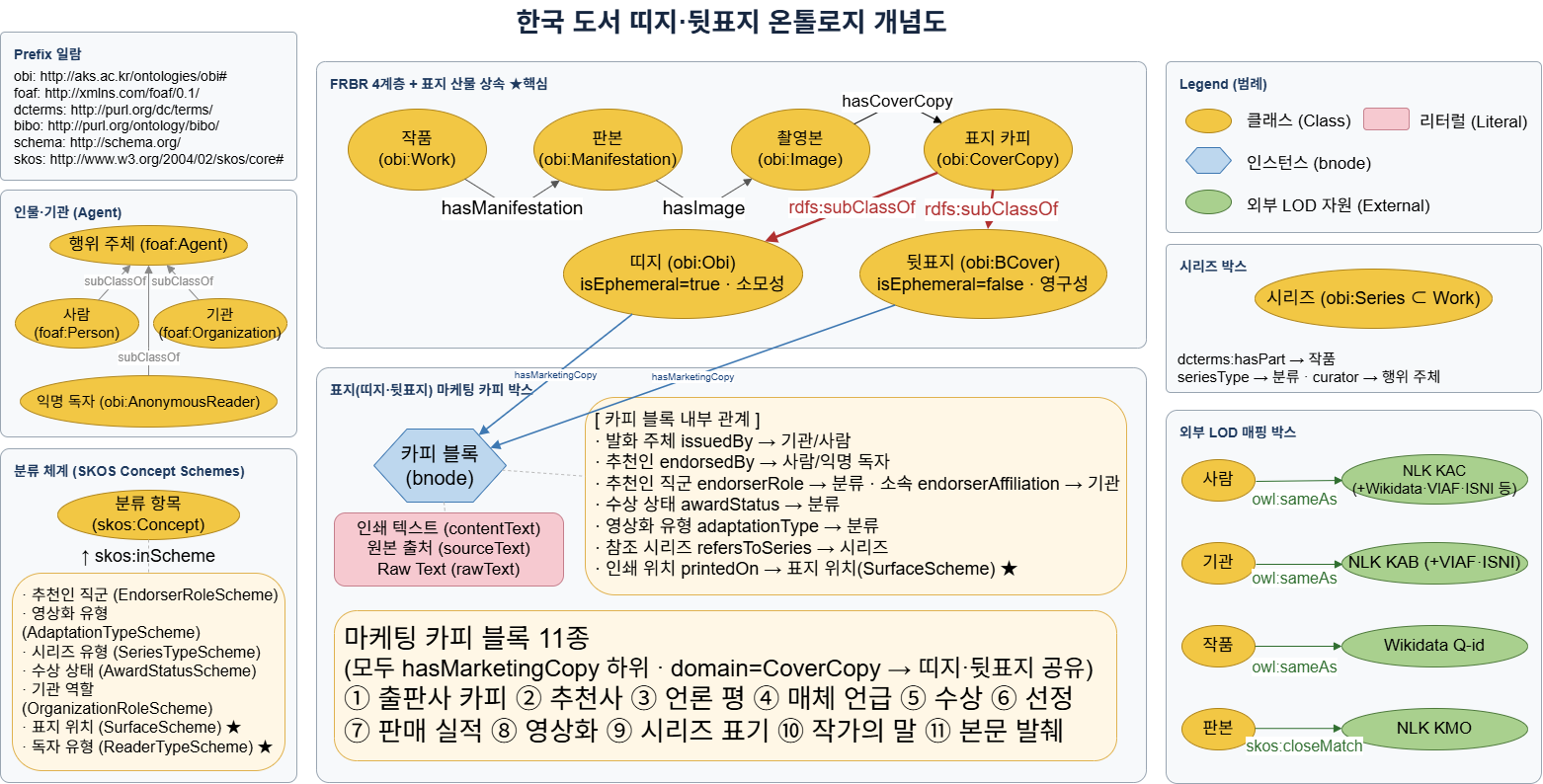
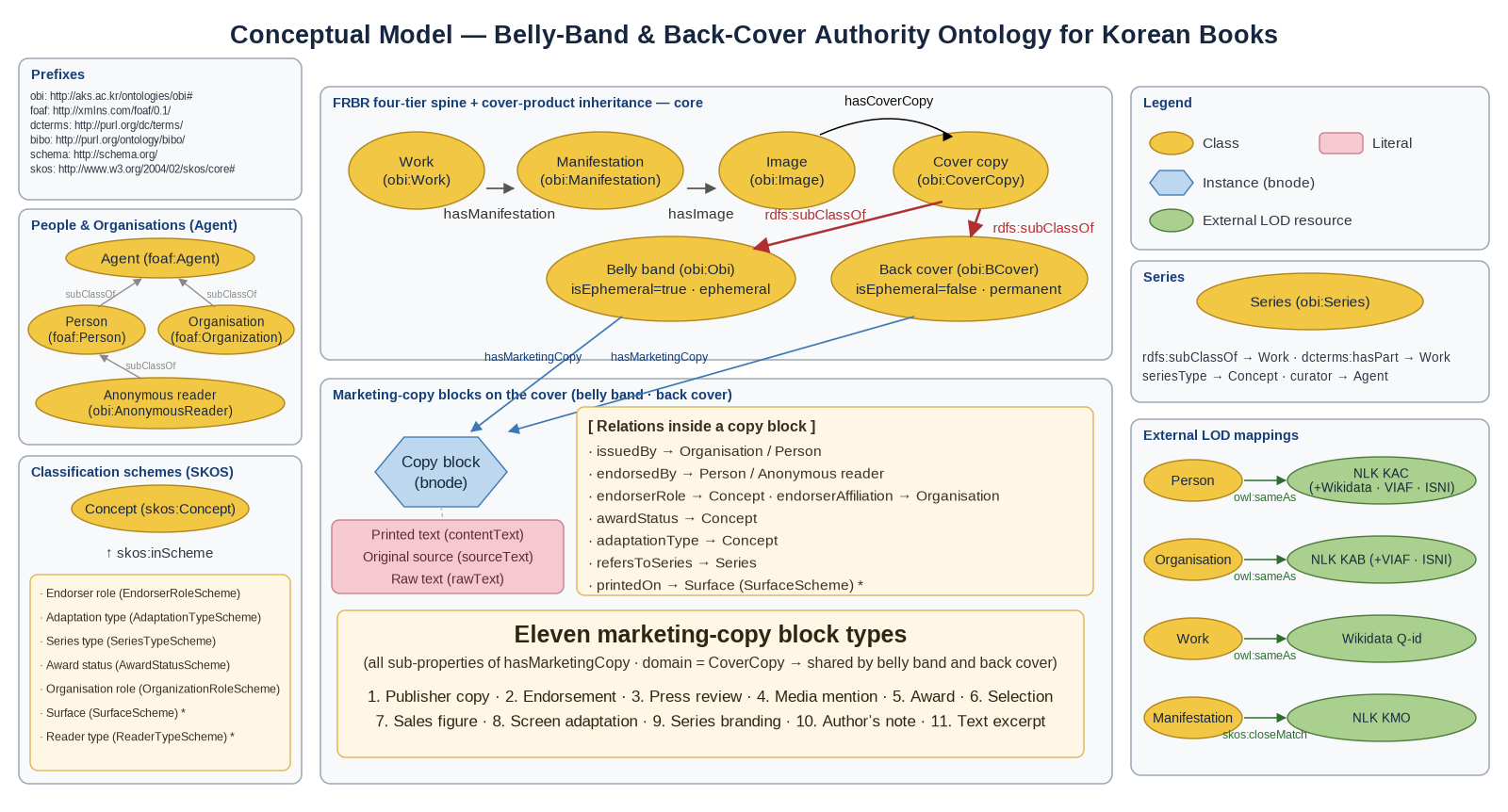
데이터 모델 전체 개념도는 본 페이지 상단 데이터 모델 개념도 절에 수록되어 있다. FRBR 4계층(작품→판본→촬영본) 위에 표지 텍스트 산물 obi:CoverCopy 가 띠지(obi:Obi, 소모성)·뒷표지(obi:BCover, 영구성)로 분기하며, 두 면이 11종 마케팅·권위 블록을 공유 상속한다.
The full diagram appears in the Data model section at the top of this page. On a four-tier FRBR spine (work → manifestation → image) sits the cover-text product obi:CoverCopy, which branches into the belly band (obi:Obi, ephemeral) and the back cover (obi:BCover, permanent); both surfaces share-inherit the eleven marketing/authority blocks.
3. Namespace · Prefix 일람3. Namespaces and prefixes
OBI 데이터를 SPARQL 로 조회하거나 RDF 도구에서 직접 다룰 때 사용하는 namespace prefix 일람.
The prefixes to declare when querying OBI with SPARQL or loading it into an RDF toolchain.
| Prefix | URI |
|---|---|
obi |
http://aks.ac.kr/ontologies/obi# |
foaf |
http://xmlns.com/foaf/0.1/ |
dcterms |
http://purl.org/dc/terms/ |
bibo |
http://purl.org/ontology/bibo/ |
schema |
http://schema.org/ |
skos |
http://www.w3.org/2004/02/skos/core# |
xsd |
http://www.w3.org/2001/XMLSchema# |
rdfs |
http://www.w3.org/2000/01/rdf-schema# |
owl |
http://www.w3.org/2002/07/owl# |
nlk |
http://lod.nl.go.kr/resource/ |
wd |
http://www.wikidata.org/entity/ |
4. 자원 식별 체계 (URI 패턴)4. Resource identifiers (URI patterns)
OBI 의 자원 URI 는 불투명(opaque) 식별자로 부여된다. URI 자체에는 이름·의미를 담지 않으며, 자원의 이름·제목 등 의미 정보는 rdfs:label·skos:prefLabel 에 둔다(이유 §10.2). 판본·촬영본·표지 산물은 ISBN13(+시점 슬롯)으로, 작품·인물·기관·분류 Concept 은 무의미 일련번호로 minting 한다.
OBI mints opaque URIs. The URI itself carries no name or meaning; labels and titles live in rdfs:label and skos:prefLabel (rationale in §10.2). Manifestations, images and cover products are keyed on ISBN-13 (plus a slot for the moment); works, persons, organisations and classification concepts receive meaningless serial numbers.
| 자원 유형Resource type | URI 패턴URI pattern | 예시Example |
|---|---|---|
| 작품Work | obi:Work_{nnnnnn} |
obi:Work_000001 |
| 시리즈Series | obi:Series_{nnnnnn} |
obi:Series_000078 |
| 판본Manifestation | obi:Mani_{ISBN13} |
obi:Mani_9788936434120 |
| 촬영본Image | obi:Image_{ISBN}[_{year\|pub}] |
obi:Image_9788936434120_2021 |
| 띠지Belly band | obi:Obi_{ISBN}[_{year\|pub}] |
obi:Obi_9788936434120_2021 |
| 뒷표지Back cover | obi:BCover_{ISBN}[_{year\|pub}] |
obi:BCover_9788901105574 |
| 사람Person | obi:Person_{nnnnnn} |
obi:Person_000016 |
| 기관Organisation | obi:Org_{nnnnnn} |
obi:Org_000001 |
| 익명 독자Anonymous reader | obi:AnonymousReader_{nnnnnn} |
obi:AnonymousReader_000001 (단일 인스턴스) |
| 추천인 직군Endorser occupation | obi:Role_{nnnnnn} |
obi:Role_000020 |
| 영상화 유형Adaptation type | obi:AdaptType_{nnnnnn} |
obi:AdaptType_000001 |
| 시리즈 유형Series type | obi:SeriesType_{nnnnnn} |
obi:SeriesType_000002 |
| 수상 상태Award status | obi:AwardStatus_{nnnnnn} |
obi:AwardStatus_000001 |
| 기관 역할Organisation role | obi:OrgRole_{nnnnnn} |
obi:OrgRole_000001 |
따라서 출판사 "문학과지성사"는 URI 가 아니라 불투명 URI(예
obi:Org_000123)에skos:prefLabel "문학과지성사"@ko로 표상된다. 이명 통합(§10.3·§10.4)은 여러 표기를 하나의 불투명 URI 로 모아 대표 이름을 prefLabel, 이명을 altLabel 로 붙이는 과정이다. (뒷표지 신규 인물·기관 124건도 불투명 ID 로 정규화 완료 — 전 자원이 불투명 URI 이며 이름은 라벨로 보존.)
The publisher Moonji, then, is represented not by a speaking URI but by an opaque one (e.g.
obi:Org_000123) bearingskos:prefLabel "문학과지성사"@ko. Merging name variants (§10.3, §10.4) means gathering several spellings under one opaque URI, attaching the canonical form as prefLabel and the variants as altLabel. (The 124 people and organisations newly introduced by the back-cover data have also been re-minted as opaque IDs, so every resource now has an opaque URI and every name lives in a label.)
시점 슬롯의 의미
What the time slot means
_{year}(예:_2021) — 연도별 베스트셀러 표지에서 검출된 띠지. 같은 ISBN 의 책이 2021·2022·2023 베스트셀러였다면 시점별로 별도 Image 가 생성된다._{year}(e.g._2021) — a belly band detected on the cover as listed in that year’s bestseller chart. If the same ISBN charted in 2021, 2022 and 2023, a separate Image is created for each moment._pub— 출판사 카테고리 페이지에서 단일 시점 수집된 띠지. 연도 정보가 없는 경우 사용._pub— a belly band collected once from a publisher’s catalogue page, used where no year is available.
5. 클래스 정의5. Class definitions
OBI 의 자원은 7개 핵심 클래스로 분류된다. FRBR(Functional Requirements for Bibliographic Records) 의 4계층 모델을 따르되, 띠지의 텍스트 산물을 별도 클래스로 분리하였다.
OBI sorts its resources into seven core classes. It follows the four-tier FRBR (Functional Requirements for Bibliographic Records) model, but splits the cover’s text product off into a class of its own.
5.1 핵심 자원 클래스5.1 Core resource classes
FRBR 4계층 + 시리즈로 구성된다.
The four FRBR tiers, plus series.
| 클래스Class | 부모 클래스Parent class | 설명Description | 예시Example |
|---|---|---|---|
obi:Work |
(없음)(none) | 추상적 저작물. ISBN 무관 한 작품의 정체성.The abstract work — the identity of a text, independent of any ISBN. | "소년이 온다"“Human Acts” (소년이 온다) |
obi:Series |
obi:Work |
여러 작품을 묶는 시리즈.A series binding several works together. | "위픽 시리즈"the Wefic series |
obi:Manifestation |
(없음)(none) | ISBN 1:1 의 특정 판본.A specific manifestation, one-to-one with an ISBN. | "소년이 온다 (창비, 양장본 2014)"Human Acts (Changbi, hardcover, 2014) |
obi:Image |
(없음)(none) | 한 시점의 표지+띠지 디지털 스캔.A digital scan of cover + belly band at one moment in time. | "9788936434120 의 2021 베스트셀러 페이지 표지"the cover of 9788936434120 as listed in 2021 |
obi:Obi |
(없음)(none) | 띠지 텍스트 산물. Image 에서 추출.The belly-band text product, extracted from an Image. | (위 Image 에서 OCR+LLM 으로 추출된 띠지 텍스트)(belly-band text extracted from the Image above by OCR + LLM) |
5.2 행위 주체 (FOAF 차용 + 자체 확장)5.2 Agents (FOAF, with one local extension)
저자·추천인·출판사 등 띠지에 등장하는 모든 인물·기관·집단의 상위 클래스 체계.
The class hierarchy covering every person, institution and collective that appears on a cover — authors, endorsers, publishers.
| 클래스Class | 부모Parent | 설명Description |
|---|---|---|
foaf:Agent |
(없음)(none) | 모든 행위 주체의 상위Superclass of every agent |
foaf:Person |
foaf:Agent |
자연인 (저자·추천인·평론가)A natural person (author, endorser, critic) |
foaf:Organization |
foaf:Agent |
기관 (출판사·언론사·시상기관·대학)An organisation (publisher, news outlet, awarding body, university) |
obi:AnonymousReader |
foaf:Agent |
익명 독자 placeholder. 단일 인스턴스 obi:AnonymousReader_독자 로 모든 익명 추천을 통합 표상한다. 식별 가능한 한 사람의 entity 가 아니라 익명 집단을 한 데 묶는 자리표시자다. |
5.3 분류 체계 (SKOS)5.3 Classification (SKOS)
| 클래스Class | 설명Description |
|---|---|
skos:Concept |
분류 항목 (예: "평론가"·"드라마")A classification term (e.g. “critic”, “TV drama”) |
skos:ConceptScheme |
분류 체계 자체 (5종, §7.2 참조)A classification scheme (five of them — see §7.2) |
6. 속성 정의6. Property definitions
OBI 가 사용하는 속성은 자원 간 관계를 표현하는 Object Property 와 텍스트·날짜·식별자 등 값을 표현하는 Datatype Property 로 나뉜다.
OBI’s properties divide into object properties, which express relations between resources, and datatype properties, which carry values such as text, dates and identifiers.
6.1 Object Properties
6.1.1 FRBR 계층 체인6.1.1 The FRBR chain
작품에서 띠지까지 4계층을 연결하는 핵심 관계.
The relations that chain the four tiers from work down to belly band.
| 속성Property | 도메인 → 레인지Domain → Range | 설명Description |
|---|---|---|
obi:hasManifestation |
obi:Work → obi:Manifestation |
한 작품이 여러 판본을 가질 수 있다A work may have several manifestations |
obi:hasImage |
obi:Manifestation → obi:Image |
한 판본이 시점별 여러 촬영본을 가질 수 있다A manifestation may have several images, one per moment |
obi:hasObi |
obi:Image → obi:Obi |
한 촬영본에서 추출된 띠지The belly band extracted from an image |
obi:extractedFrom |
obi:Obi → obi:Image |
hasObi 의 역방향 |
6.1.2 작품의 기여자6.1.2 Contributors to a work
저자 외에 편집자·번역자·원작자·기타 기여자를 명시적으로 구분한다.
Besides the author, editors, translators, authors of source works and other contributors are distinguished explicitly.
| 속성Property | 도메인 → 레인지Domain → Range | 설명Description |
|---|---|---|
dcterms:creator |
obi:Work → foaf:Person |
주 저자 (다중 가능)Principal author (repeatable) |
bibo:editor |
obi:Work → foaf:Person |
편집자 (선집 엮은이)Editor (of an anthology) |
bibo:translator |
obi:Work → foaf:Person |
번역자Translator |
obi:originalAuthor |
obi:Work → foaf:Person |
원작자 (노벨라이즈·각색의 source)Author of the source work (for novelisations and adaptations) |
dcterms:contributor |
obi:Work → foaf:Person |
기타 기여자 (해설·사진작가)Other contributor (afterword writer, photographer) |
6.1.3 출판사·시리즈6.1.3 Publishers and series
| 속성Property | 도메인 → 레인지Domain → Range | 설명Description |
|---|---|---|
dcterms:publisher |
obi:Manifestation → foaf:Organization |
현 판본 출판사Publisher of the current manifestation |
obi:formerPublisher |
obi:Manifestation → foaf:Organization |
이전 출판사 (출판권 이양 이력)Former publisher (record of transferred rights) |
dcterms:hasPart |
obi:Work → obi:Work |
작품/시리즈가 다른 작품을 포함A work or series contains another work |
obi:seriesType |
obi:Series → skos:Concept |
시리즈 유형 (저자연작·큐레이션·전집)Series type (author sequence, curated line, collected set) |
obi:curator |
obi:Series → foaf:Agent |
시리즈 기획자 (저자와 분리)Series curator (distinct from the author) |
obi:organizationRole |
foaf:Organization → skos:Concept |
기관의 다중 역할 태그Multi-role tag for an organisation |
6.1.4 마케팅 카피 부착 (Obi → bnode)6.1.4 Attaching marketing copy (Obi → blank node)
띠지의 마케팅 카피는 11종 sub-property 로 분류되며 모두 익명 노드(bnode)에 연결된다.
Cover marketing copy is classified by eleven sub-properties, each attaching to a blank node.
| 속성Property | 설명Description |
|---|---|
obi:hasMarketingCopy |
모든 카피 블록의 상위 속성Superproperty of every copy block |
obi:hasPublisherCopy |
① 출판사 카피① Publisher copy |
obi:hasEndorsement |
② 추천사② Endorsement |
obi:hasPressCitation |
③ 언론 평③ Press notice |
obi:hasMediaMention |
④ 매체 언급④ Media mention |
obi:hasAwardMention |
⑤ 수상⑤ Award |
obi:hasSelectionMention |
⑥ 선정⑥ Selection |
obi:hasSalesRecord |
⑦ 판매 실적⑦ Sales record |
obi:hasAdaptationMention |
⑧ 영상화⑧ Screen adaptation |
obi:hasSeriesBranding |
⑨ 시리즈 표기⑨ Series branding |
obi:hasAuthorNote |
⑩ 작가의 말⑩ Author's note |
obi:hasTextExcerpt |
⑪ 본문 발췌⑪ Text excerpt |
6.1.5 카피 블록 내부 관계6.1.5 Relations inside a copy block
각 카피 블록(bnode) 안의 발화자·직군·소속·유형 등을 표현한다.
Inside each copy block (a blank node) these properties record the speaker, their occupation, their affiliation and the block’s type.
| 속성Property | 도메인 → 레인지Domain → Range | 설명Description |
|---|---|---|
obi:issuedBy |
bnode → foaf:Agent |
발화 주체 (출판사·언론사·시상기관)The speaking agent (publisher, news outlet, awarding body) |
obi:endorsedBy |
bnode → foaf:Agent |
추천인Endorser |
obi:endorserRole |
bnode → skos:Concept |
추천인 직군 (배열 허용)Endorser occupation (repeatable) |
obi:endorserAffiliation |
bnode → foaf:Organization |
추천인 소속Endorser affiliation |
obi:authoredBy |
bnode → foaf:Person |
작가의 말 작성자Writer of the author's note |
obi:aggregatedBy |
bnode → foaf:Organization |
판매 실적 집계 기관Body that compiled the sales figure |
obi:adaptationType |
bnode → skos:Concept |
영상화 유형Adaptation type |
obi:awardStatus |
bnode → skos:Concept |
수상 상태Award status |
obi:refersToSeries |
bnode → obi:Series |
참조 시리즈Referenced series |
6.2 Datatype Properties
자원의 식별자·라벨·날짜·텍스트 등 값을 표현한다.
These carry the literal values of a resource: identifiers, labels, dates, text.
6.2.1 자원 식별자·라벨6.2.1 Identifiers and labels
| 속성Property | 도메인Domain | xsd 형xsd type | 설명Description |
|---|---|---|---|
bibo:isbn13 |
obi:Manifestation |
string |
ISBN13 |
schema:datePublished |
obi:Manifestation |
date |
출판일Publication date |
obi:coverTitle |
obi:Manifestation |
string@ko |
표지 인쇄 제목Title as printed on the cover |
obi:aladinItemId |
obi:Manifestation |
string |
알라딘 상품 IDAladin product ID |
obi:aladinURL |
obi:Manifestation |
URI | 알라딘 상품 페이지Aladin product page |
obi:aladinCategoryId |
obi:Manifestation |
string |
알라딘 카테고리 IDAladin category ID |
obi:aladinCategoryName |
obi:Manifestation |
string |
알라딘 카테고리명 (예: "국내도서>소설/시/희곡>한국소설")Aladin category name (e.g. Domestic > Fiction/Poetry/Drama > Korean fiction) |
obi:isKoreanNovel |
obi:Manifestation |
boolean |
한국소설 여부 (알라딘 카테고리 기반)Whether the title is Korean fiction (from the Aladin category) |
obi:hasBellyBandVerified |
obi:Manifestation |
boolean |
띠지 양면 검증 완료 여부Whether both faces of the belly band have been verified |
obi:aladinAuthorId |
foaf:Person |
string |
알라딘 작가 IDAladin author ID |
obi:aladinAuthorURL |
foaf:Person |
URI | 알라딘 작가 페이지Aladin author page |
obi:seriesName |
obi:Series |
string |
시리즈 이름Series name |
6.2.2 이미지·OCR provenance6.2.2 Image and OCR provenance
| 속성Property | 도메인Domain | xsd 형xsd type | 설명Description |
|---|---|---|---|
obi:frontImage |
obi:Image |
URI | 앞면 이미지Front image |
obi:backImage |
obi:Image |
URI | 뒷면 이미지Back image |
obi:imageSource |
obi:Image |
URI | 원본 출처 (알라딘 cover)Source of the original (Aladin cover) |
obi:imageCapturedAt |
obi:Image |
dateTime |
이미지 캡처 일시Image capture timestamp |
obi:collectionDate |
obi:Image |
date |
수집 일자Collection date |
obi:rawText |
obi:Obi |
string@ko |
OCR 원본 텍스트Raw OCR text |
obi:ocrEngine |
obi:Obi |
string |
OCR 엔진 (gemini-2.5-flash)OCR engine (gemini-2.5-flash) |
obi:ocrExtractedAt |
obi:Obi |
dateTime |
OCR 추출 일시OCR extraction timestamp |
6.2.3 마케팅 블록 텍스트 필드6.2.3 Text fields of a marketing block
| 속성Property | xsd 형xsd type | 설명Description |
|---|---|---|
obi:contentText |
string@ko |
필수 — 띠지에 인쇄된 텍스트 |
obi:sourceText |
string@ko |
외부 원본 출처 (작품명·인터뷰·신문명 등)External source of the quotation (a work, interview, newspaper …) |
obi:awardName |
string@ko |
상명 (예: "노벨문학상")Name of the prize (e.g. the Nobel Prize in Literature) |
obi:awardYear |
gYear |
수상 연도Year of the award |
obi:awardEdition |
positiveInteger |
수상 회차 (예: 39)Edition number of the award (e.g. 39th) |
obi:selectionCategory |
string@ko |
선정 카테고리Selection category |
obi:selectionYear |
gYear |
선정 연도Year of selection |
obi:selectionScope |
string@ko |
선정 범위Scope of the selection |
obi:salesMilestone |
string/integer |
판매 실적Sales figure |
obi:citationYear |
gYear |
언론 평·매체 언급 시점Date of the press notice or media mention |
6.2.4 외부 링크 provenance·신뢰도6.2.4 External-link provenance and confidence
각 foaf:Person·foaf:Organization 의 외부 LOD 링크 상태·근거·신뢰도를 자기기록(self-documenting)하는 주석 속성. 상세 의미는 §8.2 참조.
Annotation properties by which every foaf:Person and foaf:Organization self-documents the state, the evidence and the confidence of its external LOD links. See §8.2 for what each value means.
| 속성Property | 도메인Domain | xsd 형xsd type | 설명Description |
|---|---|---|---|
obi:linkageStatus |
foaf:Person/Organization |
string |
링크 상태 8종 (linked_nlk · linked_external · not_in_nlk · ambiguous_homonym · foreign_nonkorean · corporate_body · collective)One of eight link states (linked_nlk · linked_external · not_in_nlk · ambiguous_homonym · foreign_nonkorean · corporate_body · collective) |
obi:linkageMethod |
foaf:Person/Organization |
string |
매칭 방법(다중 가능). 예: local_kac_kmo · aladin_bio · bio_worktitle · manual_verifiedMatching method, repeatable (local_kac_kmo · aladin_bio · bio_worktitle · manual_verified …) |
obi:linkageConfidence |
foaf:Person/Organization |
string |
신뢰도 3등급 (high · medium · review)Confidence, in three tiers (high · medium · review) |
obi:linkageEvidence |
foaf:Person/Organization |
integer |
동명이인 NLK 후보 수 (미링크 분류의 증거)Number of homonymous NLK candidates — the evidence for leaving a name unlinked |
7. 마케팅 카피 블록 11종 상세7. The eleven marketing-copy blocks in detail
띠지에 인쇄되는 마케팅 텍스트는 의미에 따라 11종 블록으로 분류된다. 각 블록은 공통 필드(contentText)와 블록별 고유 필드(추천사라면 endorsedBy·endorserRole, 수상이라면 awardName·awardStatus 등)를 갖는다.
The marketing text printed on a cover is classified by meaning into eleven blocks. Each block has a common field (contentText) plus fields of its own — an endorsement carries endorsedBy and endorserRole, an award carries awardName and awardStatus, and so on.
7.1 블록별 필드 사용 매트릭스7.1 Which fields each block uses
각 블록 유형에서 어떤 필드를 사용하는지 정리한다. ✓ = 필수, ◐ = 선택.
Which fields each block type uses. ✓ = required, ◐ = optional.
| 블록Block | content | source | issuedBy | endorsedBy | endorserRole | endorserAffil | authoredBy | aggregated | award* | selection* | sales | adaptation | refers | citation |
|---|---|---|---|---|---|---|---|---|---|---|---|---|---|---|
| ① 출판사 카피① Publisher copy | ✓ | ◐ | ◐ | |||||||||||
| ② 추천사② Endorsement | ✓ | ◐ | ◐ | ◐ | ◐ | |||||||||
| ③ 언론 평③ Press notice | ✓ | ◐ | ◐ | ◐ | ||||||||||
| ④ 매체 언급④ Media mention | ✓ | ◐ | ◐ | ◐ | ||||||||||
| ⑤ 수상⑤ Award | ✓ | ◐ | ◐ | ✓ | ||||||||||
| ⑥ 선정⑥ Selection | ✓ | ◐ | ◐ | ✓ | ||||||||||
| ⑦ 판매 실적⑦ Sales record | ✓ | ◐ | ✓ | |||||||||||
| ⑧ 영상화⑧ Screen adaptation | ✓ | ◐ | ◐ | ✓ | ||||||||||
| ⑨ 시리즈 표기⑨ Series branding | ✓ | ✓ | ||||||||||||
| ⑩ 작가의 말⑩ Author's note | ✓ | ◐ | ◐ | |||||||||||
| ⑪ 본문 발췌⑪ Text excerpt | ✓ | ◐ |
7.2 분류 체계 5종 (SKOS Concept Schemes)7.2 The five SKOS concept schemes
마케팅 블록에서 발화자의 직군·영상화 유형·시리즈 유형 등을 표현하기 위한 표준 분류 체계 5종.
Five controlled vocabularies for the values used inside marketing blocks: endorser occupation, adaptation type, series type, award status and organisation role.
EndorserRoleScheme (추천인 직군 분류)
추천 블록의 endorserRole 값. 다중 직위 부착 가능 (예: 평론가 + 교수).
예시: obi:Role_소설가, obi:Role_평론가, obi:Role_교수, obi:Role_배우, obi:Role_시인, obi:Role_에세이스트, obi:Role_기자
EndorserRoleScheme — the endorser’s occupation.
Values of endorserRole in an endorsement block; several may be attached at once (critic + professor, say).
Examples: novelist, critic, professor, actor, poet, essayist, journalist.
AdaptationTypeScheme (영상화 유형 분류)
hasAdaptationMention 블록의 adaptationType 값.
예시: obi:AdaptType_영화, obi:AdaptType_드라마, obi:AdaptType_뮤지컬, obi:AdaptType_오디오북
AdaptationTypeScheme — the kind of adaptation.
Values of adaptationType in a hasAdaptationMention block.
Examples: film, TV drama, musical, audiobook.
SeriesTypeScheme (시리즈 유형 분류)
obi:seriesType 값. 3종.
SeriesTypeScheme — the kind of series.
Values of obi:seriesType; three of them.
| Concept | 설명Description | 예Example |
|---|---|---|
obi:SeriesType_저자연작 |
한 저자의 연작A sequence by one author | 해리포터Harry Potter |
obi:SeriesType_큐레이션시리즈 |
출판사 기획 시리즈A publisher-curated line | 위픽 시리즈, 문학동네 시인선the Wefic series; the Munhakdongne poetry line |
obi:SeriesType_전집 |
번역·고전 중심 완결 세트A closed set, typically of translations or classics | 열린책들 세계문학전집the Open Books World Literature series |
AwardStatusScheme (수상 상태 분류)
3종: obi:AwardStatus_수상, obi:AwardStatus_최종후보, obi:AwardStatus_후보
AwardStatusScheme — how far the book got. Three values: won, shortlisted, longlisted/nominated.
OrganizationRoleScheme (기관 역할 분류)
한 기관 다중 역할 가능 (예: 창비 = 출판사 + 수상주체).
예시: obi:OrgRole_출판사, obi:OrgRole_언론, obi:OrgRole_수상주체, obi:OrgRole_집계기관, obi:OrgRole_기획레이블, obi:OrgRole_제작사
OrganizationRoleScheme — what an institution does here. One body may hold several roles at once (Changbi is both publisher and awarding body). Examples: publisher, press, awarding body, compiler of figures, imprint, production company.
8. 외부 LOD 매핑 정책8. External-LOD mapping policy
OBI 의 인물·기관·작품·판본은 가능한 한 외부 LOD 자원에 연결된다. 매핑 술어는 자원의 의미적 동등성에 따라 신중히 선택된다.
OBI links its people, institutions, works and manifestations to external LOD resources wherever it can. The mapping predicate is chosen according to how strictly the two resources are equivalent.
8.1 매핑 술어8.1 Mapping predicates
| 대상 클래스Domain class | 매핑 술어Mapping predicate | 외부 LODExternal LOD |
|---|---|---|
foaf:Person |
owl:sameAs |
NLK KAC (1차 매핑). KAC 자체가 Wikidata · VIAF · ISNI · GND · BNF · BNE · NDL · LoC · DBpedia · Libris · WorldCat · IDref 와 매핑되어 있어, 한 작가에 대해 10여 개 외부 자원이 자동 연결된다.NLK KAC as the primary anchor. Because KAC is itself mapped to Wikidata, VIAF, ISNI, GND, BnF, BNE, NDL, LoC, DBpedia, Libris, WorldCat and IdRef, one author typically acquires a dozen external identifiers at once. |
foaf:Organization |
owl:sameAs |
NLK KAB · Wikidata · VIAF · ISNI |
obi:Work |
owl:sameAs |
Wikidata Q-id (NLK 측 Work 단위 자원 없음)Wikidata Q-id (NLK has no work-level resource) |
obi:Manifestation |
skos:closeMatch |
NLK KMO. owl:sameAs 대신 closeMatch 를 쓰는 이유: KMO 는 MARC 서지 record 로 한 KMO 가 여러 ISBN 을 묶을 수 있어 카디널리티가 1:1 이 아니다. sameAs 적용 시 reasoner 가 두 Manifestation 을 잘못 동일시할 위험이 있다. |
| 주제Subject | dcterms:subject |
NLK KSH URI 직접 값The NLK KSH URI directly |
| 장르Genre | schema:genre |
Wikidata Q-id 직접 값The Wikidata Q-id directly |
기관 간 계층은 모델링하지 않는다. 모회사·자회사·imprint 관계는 한국 출판업계 자료가 부족하고 시기별 변동이 심해, 외부 권위 데이터(Wikidata·VIAF)에 위임한다.
Hierarchies between institutions are deliberately not modelled. Parent-company, subsidiary and imprint relations are poorly documented in Korean publishing and change often, so OBI delegates them to external authorities (Wikidata, VIAF).
8.2 링크 상태·신뢰도 (provenance 주석)8.2 Link state and confidence (provenance annotations)
모든 foaf:Person·foaf:Organization 은 외부 링크 상태를 obi:linkageStatus 로 자기기록한다. 설계 원칙은 "링크 가능한 건 전부 링크, 불가능한 건 전부 사유 범주화" — 미분류 인스턴스는 0건이다. 이로써 사용자는 "왜 이 인물은 KAC 가 없는가"를 추측하지 않고 그래프에서 직접 읽을 수 있다.
Every foaf:Person and foaf:Organization records its own linking state in obi:linkageStatus. The principle is link everything linkable, and give a reason for everything that is not — no instance is left unclassified. A user can therefore read why a given person has no KAC authority straight off the graph, instead of guessing.
링크 상태 8종 (obi:linkageStatus)
The eight link states (obi:linkageStatus)
| 값Value | 의미Meaning |
|---|---|
linked_nlk |
NLK 권위(KAC/KAB) 직결Linked directly to an NLK authority (KAC/KAB) |
linked_external |
NLK 없음, 알라딘/Wikidata/VIAF/ISNI 등 외부만 보유Absent from NLK; linked only to external sources (Aladin, Wikidata, VIAF, ISNI …) |
ambiguous_homonym |
미링크 + NLK 동명이인 후보 2+ (수동 영역). 후보 수는 obi:linkageEvidence |
not_in_nlk |
미링크 + NLK 미수록 (외국 표기·필명 포함)Unlinked and absent from NLK (includes foreign forms and pen names) |
foreign_nonkorean |
미링크 + 비한글 표기Unlinked, non-Hangul form of name |
corporate_body |
단체·법인-저자Corporate body as author |
collective |
복수 인명 결합 문자열A string combining several personal names |
신뢰도 3등급 (obi:linkageConfidence) — KAC 매칭의 근거 강도
Three confidence tiers (obi:linkageConfidence) — how strong the evidence for a KAC match is
| 등급Tier | 의미Meaning | 주요 방법Principal evidence |
|---|---|---|
high |
작품(KMO)겹침·생년·대표작·사람검증 등 강증거Strong evidence — overlapping works (KMO), birth year, signature title, human verification | local_kac_kmo · aladin_bio · bio_worktitle · manual_verified |
medium |
단일 비문학 후보·직업 유일생존 등 보조 증거Supporting evidence — a single non-literary candidate, or one surviving occupation match | local_kac_single · coauthor · kn_* |
review |
저정밀 자동매칭·모호 — 수동 검토 권장Low-precision automatic match or ambiguous — manual review recommended | kmo_title · local_kac_ambiguous |
obi:linkageMethod 는 매칭이 어느 경로로 이뤄졌는지 기록하며(다중 가능), 검수 우선순위 판단·재현에 쓰인다.
obi:linkageMethod records by which route a match was made (repeatable); it is used to prioritise review and to reproduce the linking.
8.3 동명이인 disambiguation 방법론8.3 Disambiguating homonyms
동명이인 해소는 다음 신호를 증거 강도 순으로 결합한다. 모두 사람의 주관이 아닌 데이터 증거에 기반한다.
Homonyms are resolved by combining the following signals in order of evidential strength. All rest on data, none on an annotator’s impression.
- KMO 작품 겹침 — NLK 후보의 등록작(KMO)이 ABox 판본의 KMO 와 일치 (최강)
- Overlapping works (KMO) — a work registered to the NLK candidate matches a manifestation in the ABox. The strongest signal.
- 생년 일치 — 알라딘 작가 bio 의 출생연도 ↔ NLK
birthYear - Matching birth year — the year in the Aladin author biography against NLK
birthYear. - 대표작 제목 일치 — bio 의 대표작(《》) ↔ 후보의 등록작 제목(book.json title)
- Matching signature title — the work named in the biography against the candidate’s registered titles.
- 직업 일치 — bio 의 직업 ↔ NLK
fieldOfActivity/jobTitle. 영화감독·가수·사진가 등 비문학 창작자(추천·원작 역할)도 포함 - Matching occupation — the occupation in the biography against NLK
fieldOfActivity/jobTitle. This covers non-literary creators too (film directors, singers, photographers) who appear as endorsers or as authors of source works.
알라딘 bio 활용: 알라딘 authors[].authorInfo(작가 소개)에 담긴 생년·직업·대표작은 동명이인 해소의 핵심 단서다. 유명도 추정 같은 휴리스틱보다 안전하며, 잘못 붙은 링크를 자동 교정하는 데에도 쓰였다.
Using the Aladin biography. The birth year, occupation and signature works in Aladin’s authors[].authorInfo are the decisive clues for separating homonyms. They are safer than heuristics such as guessing at fame, and were also used to correct links that had been attached wrongly.
사람 검수 루프: 자동 매칭 결과는 인터랙티브 HTML 검수 도구로 사람이 승인/반려/수정할 수 있으며, 확정분은 manual_verified(high)로 기록되고 잘못된 링크는 제거된다.
A human review loop. Automatic matches can be approved, rejected or corrected in an interactive HTML review tool; confirmed ones are recorded as manual_verified (high confidence) and bad links are deleted.
9. 직렬화9. Serialisation
과제 제출 스키마는 표준 RDF/XML (OWL 2) 한 가지로 제공된다.
The schema is released in a single standard serialisation, RDF/XML (OWL 2).
| 파일File | 직렬화Serialisation | 마케팅 카피 표현Marketing-copy representation | 호환성Compatibility |
|---|---|---|---|
OBI_온톨로지_스키마.owl |
RDF/XML (표준 OWL 2)RDF/XML (standard OWL 2) | blank node + DP/OP | Protégé 호환Protégé-compatible |
마케팅 카피 블록은 표준 OWL 2 의 blank node + DP/OP 로 표현한다. (rdf-star(Turtle-star) reification 변이도 연구용으로 구성 가능하나 — Jena 4.x/rdflib 6+ 필요, Protégé 미지원 — 본 제출본에는 표준 RDF/XML 만 포함한다.)
Marketing-copy blocks are expressed with standard OWL 2 blank nodes plus datatype and object properties. An rdf-star (Turtle-star) reification variant can be produced for research use, but it requires Jena 4.x or rdflib 6+ and is unsupported in Protégé, so only the standard RDF/XML is released here.
10. 명명 규약10. Naming conventions
표기 규약: 본 절에서
Org_문학과지성사·Org_RHK처럼 적은 것은 가독성을 위한 대표 라벨(prefLabel) 지칭이며, 실제 URI 는 불투명 일련번호(obi:Org_000123)다(§4).
A note on notation. Where this section writes things like
Org_문학과지성사orOrg_RHK, it is naming the resource by its prefLabel for readability; the actual URI is an opaque serial number such asobi:Org_000123(§4).
10.1 정규화 키(slug) 생성 룰10.1 How normalisation keys (slugs) are built
slug 는 URI 가 아니라 이명 통합용 정규화 키(대표 prefLabel 산출용)다. 자원 이름에서 한글·영문·숫자만 남기고 공백·특수문자를 제거해, 같은 entity 의 표기 변이를 한 키로 모은다. 실제 URI 는 이 키와 무관하게 불투명 일련번호(§4)로 부여된다.
A slug is not a URI but a normalisation key used to merge name variants and derive a canonical prefLabel. It keeps only Hangul, Latin letters and digits, dropping spaces and punctuation, so that variant spellings of one entity collapse onto a single key. The URI itself is minted independently as an opaque serial number (§4).
def slugify(name: str) -> str:
    return re.sub(r"[^가-힣A-Za-z0-9]", "", name or "")
예: "문학과 지성사"·"문학과의 지성사" → 정규화 키 문학과지성사 → 한 entity(obi:Org_000123, prefLabel "문학과지성사")로 통합.
For example, two spacing variants of the publisher Moonji both normalise to the key 문학과지성사 and merge into one entity, obi:Org_000123, whose prefLabel is 문학과지성사.
10.2 라벨 부착 정책10.2 Labelling policy
한 자원에 같은 언어의 라벨이 여럿 있을 때 rdfs:label 을 중복 선언하지 않는다. 대표 이름만 rdfs:label + skos:prefLabel, 이명은 skos:altLabel 로 분리한다.
Where a resource has several labels in the same language, rdfs:label is not repeated. Only the canonical name takes rdfs:label and skos:prefLabel; the variants go to skos:altLabel.
예: obi:Org_창비 → prefLabel "창비"@ko, altLabel "창작과비평사"@ko
For example the publisher Changbi has prefLabel 창비 and altLabel 창작과비평사, its former full name.
10.3 출판사 정규화10.3 Normalising publisher names
메타 publisher 문자열의 X(Y) 패턴 (예: "알에이치코리아(RHK)") 은 4 유형으로 분류된다.
Publisher strings of the form X(Y) — e.g. “알에이치코리아(RHK)” — fall into four types.
| 유형Type | 정책Policy | 예Example |
|---|---|---|
| Type a — 풀네임/약자 같은 entityType a — full name vs abbreviation, same entity | 출판업계 통용 표기를 slug + 다른 표기를 skos:altLabel |
Org_RHK + altLabel "알에이치코리아" |
| Type b — 표기 변이Type b — orthographic variant | 같은 entity, altLabel 부착Same entity; the variant becomes an altLabel | Org_한즈미디어 + altLabel "한스미디어" |
| Type c — imprint/모회사Type c — imprint vs parent company | X 만 slug, Y 는 rdfs:comment 로 보존 |
Org_퍼플레인 + comment "메타데이터 원문: 퍼플레인(갈매나무)" |
| Type d — 법인 접미Type d — corporate suffix | X 만 사용, "(주)" 무시Use X alone; ignore the “(주)” (Co., Ltd.) suffix | Org_데이즈엔터 |
10.4 OCR 변이·표기 변이 자동 통합10.4 Automatic merging of OCR and spelling variants
LLM 이 추출한 OCR 오인식 표기는 사전 정의된 매핑(publisher_normalizer.py 의 _OCR_VARIANT_MAP·_AWARD_BODY_MAP)으로 canonical slug 에 자동 매핑된다.
Misreadings introduced by OCR are mapped automatically onto the canonical slug through pre-declared tables (_OCR_VARIANT_MAP and _AWARD_BODY_MAP in publisher_normalizer.py).
예:
- "문학과의 지성사" → Org_문학과지성사
- "엘리시트" / "엘리시온" → Org_엘릭시르
- "서울대학교" → Org_서울대
- "한겨레신문사" → Org_한겨레
- "부커상 위원회" → Org_부커상재단
For instance, a misspelt Moonji resolves to Org_문학과지성사; two OCR corruptions of the imprint Elixir both resolve to Org_엘릭시르; “Seoul National University” to Org_서울대; “Hankyoreh Shinmunsa” to Org_한겨레; “the Booker Prize committee” to Org_부커상재단.
11. SPARQL 사용 예시11. SPARQL examples
외부 사용자가 자주 쓸 만한 분석 패턴 5종.
Five query patterns an external user is likely to want.
11.1 한 작가의 모든 띠지 시점11.1 Every belly band of one author, over time
PREFIX obi: <http://aks.ac.kr/ontologies/obi#>
PREFIX dcterms: <http://purl.org/dc/terms/>
PREFIX bibo: <http://purl.org/ontology/bibo/>
PREFIX rdfs: <http://www.w3.org/2000/01/rdf-schema#>

SELECT ?work_label ?isbn ?year WHERE {
  obi:Person_한강 ^dcterms:creator ?work .
  ?work rdfs:label ?work_label ;
        obi:hasManifestation ?mani .
  ?mani bibo:isbn13 ?isbn ;
        obi:hasImage ?img .
  ?img obi:hasObi/obi:collectionDate ?year .
}
ORDER BY ?work_label ?year
11.2 영상화된 작품의 추천인 직군 분포11.2 Endorser occupations for screen-adapted works
PREFIX obi: <http://aks.ac.kr/ontologies/obi#>
PREFIX skos: <http://www.w3.org/2004/02/skos/core#>

SELECT ?role (COUNT(*) AS ?n) WHERE {
  ?work obi:hasManifestation/obi:hasImage/obi:hasObi ?obi .
  ?obi obi:hasAdaptationMention [] .
  ?obi obi:hasEndorsement/obi:endorserRole/skos:prefLabel ?role .
}
GROUP BY ?role ORDER BY DESC(?n)
11.3 출판사별 추천인 직군 다양성11.3 Diversity of endorser occupations by publisher
PREFIX obi: <http://aks.ac.kr/ontologies/obi#>
PREFIX dcterms: <http://purl.org/dc/terms/>
PREFIX skos: <http://www.w3.org/2004/02/skos/core#>
PREFIX foaf: <http://xmlns.com/foaf/0.1/>

SELECT ?publisher (COUNT(DISTINCT ?role) AS ?role_diversity) WHERE {
  ?mani dcterms:publisher/foaf:name ?publisher ;
        obi:hasImage/obi:hasObi/obi:hasEndorsement/obi:endorserRole/skos:prefLabel ?role .
}
GROUP BY ?publisher
ORDER BY DESC(?role_diversity)
LIMIT 20
11.4 시리즈별 마케팅 카피 패턴11.4 Marketing-copy patterns by series
PREFIX obi: <http://aks.ac.kr/ontologies/obi#>
PREFIX rdfs: <http://www.w3.org/2000/01/rdf-schema#>
PREFIX dcterms: <http://purl.org/dc/terms/>

SELECT ?block_type (COUNT(*) AS ?n) WHERE {
  obi:Series_위픽시리즈 dcterms:hasPart ?work .
  ?work obi:hasManifestation/obi:hasImage/obi:hasObi ?obi .
  ?obi ?p ?b .
  ?p rdfs:subPropertyOf+ obi:hasMarketingCopy .
  BIND(REPLACE(STR(?p), "^.*#", "") AS ?block_type)
}
GROUP BY ?block_type ORDER BY DESC(?n)
11.5 다년도 띠지 변화 추적11.5 Tracking a belly band across years
같은 ISBN 의 책이 여러 해에 걸쳐 다른 띠지를 두른 경우를 식별한다.
Finds books that wore different belly bands in different years under the same ISBN.
PREFIX obi: <http://aks.ac.kr/ontologies/obi#>
PREFIX bibo: <http://purl.org/ontology/bibo/>

SELECT ?isbn (COUNT(DISTINCT ?obi) AS ?n_obi) WHERE {
  ?mani bibo:isbn13 ?isbn ;
        obi:hasImage/obi:hasObi ?obi .
}
GROUP BY ?isbn
HAVING (COUNT(DISTINCT ?obi) > 1)
ORDER BY DESC(?n_obi)
11.6 신뢰도 높은 인물 링크만 선별11.6 Selecting only high-confidence person links
분석·시각화 시 저신뢰(review) 노드를 제외하고 검증된 링크만 사용한다.
For analysis and visualisation, excludes low-confidence (review) nodes and keeps only verified links.
PREFIX obi: <http://aks.ac.kr/ontologies/obi#>
PREFIX owl: <http://www.w3.org/2002/07/owl#>
PREFIX foaf: <http://xmlns.com/foaf/0.1/>

SELECT ?person ?name ?kac WHERE {
  ?person a foaf:Person ;
          obi:linkageConfidence "high" ;
          foaf:name ?name ;
          owl:sameAs ?kac .
  FILTER(CONTAINS(STR(?kac), "/resource/KAC"))
}
미검수 대상(수동 검토 큐)만 뽑으려면 obi:linkageConfidence "review" 로 바꾼다.
To pull the manual-review queue instead, change the value to obi:linkageConfidence "review".
12. 데이터 통계12. Dataset statistics
본 절 수치는 배포 파일(
.ttl/.owl)을 rdflib 로 직접 파싱해 재계산한 값이다(스크립트01_스크립트/build_site_stats.py, 재현 가능). 전 파일 파싱 정상(구문 오류 0). 기준일 2026-07-11.
All figures below were recomputed by parsing the released
.ttl/.owlfiles directly with rdflib (script01_스크립트/build_site_stats.py, reproducible). Every file parses cleanly (0 syntax errors). As of 2026-07-11.
12.0 두 개의 코퍼스12.0 Two corpora
OBI 데이터는 수집 논리가 다른 두 갈래(arm) 로 이루어진다. 둘은 별도 파일로 배포되며, 분석 목적에 따라 합칠 수 있는지가 달라진다(§15.0).
The OBI data consists of two arms collected under different logics. They are released as separate files, and whether they may be pooled depends on the kind of analysis (see §15.0).
| 코퍼스Corpus | 수집 논리Sampling logic | 규모Size | 파일File |
|---|---|---|---|
| A. 베스트셀러A. Bestsellers | 알라딘 연도별 베스트셀러 2000–2024Aladin annual bestseller lists, 2000–2024 | 판본 2,382 · 띠지 2,935 · 뒷표지 5872,382 manifestations · 2,935 belly bands · 587 back covers | OBI_샘플데이터_ABox.ttl |
| B. big-5 출판사B. Big-5 publishers | 문학과지성사·문학동네·민음사·은행나무·창비 카탈로그 전수Full catalogues of the five major literary publishers | 판본 589 · 뒷표지 577 · 띠지 27589 manifestations · 577 back covers · 27 belly bands | OBI_big5출판사_ABox.ttl |
왜 분리하나. A 는 시장 노출(무엇이 팔렸나)의 표본이고, B 는 출판사 카탈로그(무엇이 출간되었나)의 표본이다. 부착율·시계열처럼 책-단위 분모 가 필요한 통계는 A 만으로 계산해야 하며(§15.1), 담론어 공기(共起) 구조처럼 텍스트 표본 크기 만 중요한 관계 분석은 B 를 합쳐도 무방하다(§15.2). B 는 비베스트셀러 문학서가 많아 담론이 비평·문학 쪽으로 기운다.
Why keep them apart. A samples market exposure (what sold); B samples publisher catalogues (what was issued). Statistics that need a per-book denominator — prevalence, time series — must be computed on A alone (§15.1), whereas relational analyses that only need a larger text sample — noun co-occurrence structure — may pool B (§15.2). B contains many non-bestselling literary titles and therefore tilts the discourse toward the critical/literary register.
12.1 인스턴스 수12.1 Instance counts
| 클래스Class | A. 베스트셀러 ABoxA. Bestseller ABox | B. big-5 ABoxB. Big-5 ABox |
|---|---|---|
obi:Work | 2,211 | — |
obi:Manifestation | 2,382 | 589 |
obi:Image | 3,520 | 604 |
obi:CoverCopy (materialized) | 587 | 604 |
├ obi:Obi (띠지 belly band) | 2,935 | 27 |
└ obi:BCover (뒷표지 back cover) | 587 | 577 |
obi:Series | 103 | — |
foaf:Person | 2,630 | 120 |
foaf:Organization | 781 | — |
skos:Concept | 197 | 41 |
skos:ConceptScheme | 5 | — |
obi:AnonymousReader | 1 | — |
| 총 트리플Total triples | 150,093 | 12,051 |
obi:CoverCopy수가Obi+BCover합보다 작은 것은 데이터 오류가 아니다. OBI 도구는 reasoner 없이rdf:type만 보므로 상속을 데이터에 실체화(materialize) 해야 하는데, 현재 실체화는 뒷표지 쪽에만 적용돼 있다(§14.3). 띠지에도 적용하려면?o a obi:Obi인스턴스에a obi:CoverCopy를 추가하면 된다.
obi:AnonymousReader1건(obi:AnonymousReader_000001)은 익명 독자·리뷰어 발화(알라딘 마스킹 닉네임 등)를 통합 표상하는 placeholder 다.rdfs:subClassOf foaf:Agent로 정의되어 의도적으로foaf:Person이 아니다(식별 가능한 한 사람이 아니라 익명 집단이므로). 닉네임 원문은 각 추천 블록의rdfs:comment에 보존된다.
That
obi:CoverCopyis smaller thanObi+BCoveris not an error. OBI tooling readsrdf:typewithout a reasoner, so inheritance has to be materialised in the data (§14.3), and materialisation is currently applied on the back-cover side only. To extend it, asserta obi:CoverCopyonobi:Obiinstances as well.The single
obi:AnonymousReaderis a placeholder standing for anonymous reader/reviewer utterances (masked retailer nicknames). It is declaredrdfs:subClassOf foaf:Agentand is deliberately not afoaf:Person, because it denotes an anonymous collective rather than one identifiable human. The original nicknames are preserved in each block'srdfs:comment.
12.2 마케팅·권위 블록 11종12.2 The eleven marketing/authority blocks
블록 수치는 rdflib 트리플 기준이다(한 블록 속성이 다중 값을 가질 수 있어 텍스트 줄 수와 다르다).
Block counts are triple counts in rdflib; because one block property may carry several values, they do not equal the number of text lines.
| 블록 속성Block property | A · 띠지A · belly | A · 뒷표지A · back | B · 뒷표지B · back |
|---|---|---|---|
hasPublisherCopy — 출판사 카피publisher copy | 2,952 | 634 | 502 |
hasEndorsement — 추천·권위endorsement | 1,627 | 730 | 568 |
hasAwardMention — 수상award | 910 | 44 | 52 |
hasTextExcerpt — 본문 발췌text excerpt | 811 | 521 | 374 |
hasPressCitation — 언론 인용press citation | 689 | 82 | 38 |
hasSelectionMention — 선정selection | 495 | 9 | 6 |
hasSalesRecord — 판매 실적sales record | 414 | 6 | 1 |
hasAuthorNote — 작가의 말author's note | 352 | 135 | 62 |
hasAdaptationMention — 영상화screen adaptation | 259 | 7 | — |
hasSeriesBranding — 시리즈 브랜딩series branding | 205 | 6 | 21 |
hasMediaMention — 미디어 언급media mention | 54 | 1 | 2 |
| 합계Total | 8,768 | 2,175 | 1,626 |
표면별 권위 분업이 블록 분포에 그대로 보인다. 띠지는
hasAwardMention(910)·hasSalesRecord(414)·hasSelectionMention(495) 같은 제도 인용·선언형 블록이 압도적인 반면, 뒷표지는hasEndorsement(730)·hasTextExcerpt(521)·hasAuthorNote(135) 같은 담론·논증형 블록의 비중이 크다. 즉 띠지는 "무엇이 이 책을 승인했는가"를 선언하고, 뒷표지는 "이 책이 왜 좋은가"를 논증한다. 이 관찰이 §15 분석의 출발점이다.
The surface-wise division of authority is already visible in the block distribution. The belly band is dominated by declarative institutional citation — awards (910), sales figures (414), selections (495) — whereas the back cover leans on discursive, argumentative blocks: endorsements (730), text excerpts (521), authors' notes (135). The belly band declares what has authorised this book; the back cover argues why the book is good. This observation is the starting point of the analysis in §15.
12.3 외부 링크 현황12.3 External linking
외부 자원 매칭은 인물(Person) 매칭을 최우선으로 한다. 국립중앙도서관 인물 전거(KAC)를 1차 앵커로 연결한 뒤, 그 전거 클러스터를 통해 ISNI·VIAF·Wikidata 등 국제 식별자를 함께 끌어온다.
External reconciliation is person-first: each individual is anchored to a National Library of Korea name authority (KAC), and international identifiers (ISNI, VIAF, Wikidata …) are then pulled in through that authority cluster.
| 항목Measure | A. 베스트셀러A. Bestsellers | B. big-5B. Big-5 |
|---|---|---|
| Person 총수Persons | 2,630 | 120 |
| KAC(NLK 인물전거) 보유with a KAC authority | 1,555 (59.1%) | 104 (86.7%) |
| 외부링크 1개 이상 보유with ≥1 external link | 1,670 (63.5%) | 104 (86.7%) |
신뢰도 분포 linkageConfidencelinkage confidence | high 1,264 · medium 113 · review 106 | — |
linkageStatus 미분류unclassified linkage status | 0건 — 전 개체가 링크 또는 사유 범주화none — every entity is either linked or given a reason | — |
linkageStatus 분포(A): linked_nlk 1,672 · linked_external 877 · not_in_nlk 576 · ambiguous_homonym 55 · foreign_nonkorean 53 · corporate_body 42 · collective 11 · ordinary_reader 3. 즉 연결 실패도 사유로 분류되어 있어, 미연결이 곧 결측이 아니다.
Distribution of linkageStatus in A: linked_nlk 1,672 · linked_external 877 · not_in_nlk 576 · ambiguous_homonym 55 · foreign_nonkorean 53 · corporate_body 42 · collective 11 · ordinary_reader 3. Failures to link are themselves categorised by reason, so an unlinked entity is not simply missing data.
owl:sameAs 외부 도메인 분포(A, 상위): KAC 1,555 · ISNI 1,071 · VIAF 987 · Wikidata 572 · LoC 458 · DNB 379 · DBpedia 301 · OCLC 276 · BnF 254 · IdRef 247 · NDL(일) 242 · KDATA 121 · BNE(스페인) 88. 한 인물이 KAC 앵커를 중심으로 평균 여러 국제 전거에 동시 연결된다.
Top owl:sameAs target domains in A: KAC 1,555 · ISNI 1,071 · VIAF 987 · Wikidata 572 · LoC 458 · DNB 379 · DBpedia 301 · OCLC 276 · BnF 254 · IdRef 247 · NDL (Japan) 242 · KDATA 121 · BNE (Spain) 88 — i.e. a person anchored at KAC typically resolves to several international authorities at once.
12.4 무결성·결측12.4 Integrity and coverage
| 검증 항목Check | 결과Result |
|---|---|
| 도메인/레인지 위반Domain/range violations | 0건none |
| ISBN-13 중복Duplicate ISBN-13 | 0건 (판본 2,382 전부 유일)none (all 2,382 manifestations unique) |
hasObi·hasBCover 끊긴 참조Dangling hasObi/hasBCover references | 0건none |
| KAC 매핑 정확도 (Wikidata 교차검증)KAC mapping accuracy (Wikidata cross-check) | 94.3% PASS (314건 표본)94.3% pass (sample of 314) |
| 사람 검수로 제거한 오링크Bad links removed by manual review | 20건20 |
schema:datePublished 보유has schema:datePublished | 658 / 2,382 (27.6%) — 판본연도 1994–2025658 / 2,382 (27.6%), edition years 1994–2025 |
⚠️ 판본일 결측은 이 데이터의 유일한 큰 구멍이며, 분석 레이어에서 별도로 보정한다. 배포 ABox 의
schema:datePublished보유율은 27.6%, 띠지 통합그래프 기준으로는 44.2%다. §15 의 시계열 분석은 알라딘pubDate로 백필한 별도 산출물(03_데이터_중간/full_population_authority.json)을 쓰므로 판본연도 결측이 없다. ABox 자체를 백필하는 것은 후속 작업으로 남겨 두었다 — 배포본은 원 수집값만 담는다는 원칙을 유지하기 위해서다.
⚠️ Missing edition dates are the one substantial gap in this dataset, and they are repaired in the analysis layer rather than in the release. Coverage of
schema:datePublishedis 27.6% in the released ABox and 44.2% in the belly-band integrated graph. The time series in §15 instead use a derived table (03_데이터_중간/full_population_authority.json) back-filled from AladinpubDate, which has no missing edition years. Back-filling the ABox itself is left as future work, to keep the release faithful to what was actually collected.
12.5 스키마(TBox)12.5 Schema (TBox)
| 항목Measure | 값Value |
|---|---|
| 트리플Triples | 433 |
owl:Class | 11 |
owl:ObjectProperty | 34 |
owl:DatatypeProperty | 36 |
스키마 .owl 은 띠지 TBox 와 표지권위 확장(CoverCopy·BCover·SurfaceScheme·printedOn·isEphemeral)을 단일 파일로 병합한 것이다.
The released .owl merges the original belly-band TBox with the cover-authority extension (CoverCopy, BCover, SurfaceScheme, printedOn, isEphemeral) into one file.
13. 다운로드·인용13. Download and citation
13.1 파일 일람 (4종)13.1 Released files
| 자원Resource | 파일File |
|---|---|
| ① 온톨로지 스키마 (TBox, RDF/XML)① Ontology schema (TBox, RDF/XML) | OBI_온톨로지_스키마.owl |
| ② 온톨로지 설계 명세서 (본 문서)② Design specification (this document) | 띠지 온톨로지 명세서_최종.docx |
| ③ 샘플 데이터 (ABox, Turtle, 통합)③ Instance data (ABox, Turtle, unioned) | OBI_샘플데이터_ABox.ttl |
| ④ SPARQL 질의 모음 (7종)④ SPARQL query set (7 queries) | OBI_SPARQL질의.rq |
스키마
.owl은 띠지 TBox 와 표지권위 확장(CoverCopy·BCover·SurfaceScheme·printedOn·isEphemeral)을 단일 파일로 병합한 것이다. 샘플 데이터.ttl은 띠지 통합그래프 + 뒷표지 ABox + 뒷표지 인물 KAC 링크를 하나로 합친 union(약 15만 트리플)이다. 개념도는 본 명세서 §2 에 포함되어 있다.
The released
.owlmerges the belly-band TBox with the cover-authority extension (CoverCopy, BCover, SurfaceScheme, printedOn, isEphemeral) into one file. The released.ttlis a union of the belly-band integrated graph, the back-cover ABox and the KAC links for back-cover people — about 150,000 triples. The model diagram is in §2.
13.2 외부 자료 의존성13.2 External dependencies
본 ABox 의 메타데이터·외부 매핑은 다음 자료에 의존한다.
The metadata and external mappings in this ABox depend on the following sources.
- 알라딘 OpenAPI (도서 메타·이미지)
- Aladin OpenAPI — book metadata and cover images
- 국립중앙도서관 LOD (KAC·KAB·KMO·KSH JSON dump, https://lod.nl.go.kr/)
- National Library of Korea LOD — KAC, KAB, KMO and KSH JSON dumps (https://lod.nl.go.kr/)
- Wikidata SPARQL endpoint (https://query.wikidata.org/sparql)
- Gemini 2.5 Flash (OCR + 마케팅 블록 의미 분류)
- Gemini 2.5 Flash — OCR and semantic classification of marketing blocks
13.3 인용13.3 How to cite
본 데이터 또는 명세서 인용 시 다음 형식을 권장한다 (DOI 부여 후 갱신).
When citing this dataset or specification, the following form is recommended (to be updated once a DOI is assigned).
Park, S. (2026). OBI: An ontology of belly-band and back-cover authority in Korean books (Version 2.3) [Data set and ontology]. https://sun09125.github.io/DDIJI/

박선영. (2026). OBI 띠지·표지 권위 온톨로지 (Version 2.3) [데이터셋·온톨로지]. https://sun09125.github.io/DDIJI/
14. 표지 권위 확장 (Cover-Authority Extension)14. The cover-authority extension
이 온톨로지는 띠지 전용 모델을 표지 전체 권위 로 확장한다. 확장 어휘(CoverCopy·BCover·SurfaceScheme·printedOn·isEphemeral)는 제출 스키마 OBI_온톨로지_스키마.owl 에 통합되어 있다. 핵심만 요약한다.
This extension widens a belly-band-only model into one covering the authority of the whole cover. The added vocabulary (CoverCopy, BCover, SurfaceScheme, printedOn, isEphemeral) is already merged into the released schema. The essentials follow.
14.1 상속 뿌리 obi:CoverCopy
obi:CoverCopy (표지 텍스트 산물)            ← 신설 상위(상속 뿌리)
 ├ obi:Obi    (띠지,   isEphemeral=true)    ← 소모성·즉각 마케팅
 └ obi:BCover (뒷표지, isEphemeral=false)   ← 영구·비평적 정당화
11종 마케팅 블록 속성(hasEndorsement·hasPressCitation 등)의 domain 을 obi:CoverCopy 에 둠으로써 띠지·뒷표지가 동일 어휘를 공유 상속한다. 인물(foaf:Person)·작품(obi:Work)·기관(foaf:Organization)은 그대로 재사용하여 기존 KAC/bio 매칭·신뢰도 인프라를 뒷표지 추천인에도 동일 적용한다.
Putting the domain of all eleven block properties (hasEndorsement, hasPressCitation …) on obi:CoverCopy makes the belly band and the back cover share-inherit one vocabulary. People, works and organisations are reused unchanged, so the existing KAC/biography matching and confidence machinery applies to back-cover endorsers as well.
14.2 위치(surface) 2계층 · 물질성14.2 Two levels of surface, plus materiality
- 거친 위치(띠지 vs 뒷표지) = 캐리어 클래스(
Obi/BCover)가 인코딩. - Coarse position (belly band vs back cover) is encoded by the carrier class itself,
ObiorBCover. - 미세 위치(앞면/뒷면/날개) =
obi:printedOn→obi:SurfaceScheme(SKOS) Concept. 클래스 계층은 불변, 값만 분류. - Fine position (front, reverse, flap) is a value:
obi:printedOnpointing into the SKOSobi:SurfaceScheme. The class hierarchy stays fixed; only the value varies. - 물질성 =
obi:isEphemeral(소모성/영구성)을 캐리어 클래스에 인코딩 → "교체되는 마케팅 면 vs 영구 정당화 면" 분석. - Materiality is encoded on the carrier class as
obi:isEphemeral, which is what allows the replaceable marketing surface to be analysed against the permanent surface of justification.
14.3 무(無)reasoner 주의 (materialize)14.3 No reasoner — materialise instead
OBI 도구는 reasoner 없이 rdf:type 만 직접 본다. 상속을 데이터에 실체화하려면 BCover/Obi 인스턴스를 obi:CoverCopy 로도 함께 타이핑한다(뒷표지 ABox 는 이미 적용됨 — ?x a obi:CoverCopy 즉시 작동). 상속 속성 경로 질의는 rdfs:subPropertyOf* 를 명시한다(OBI_SPARQL질의.rq 07번 참조).
OBI tooling reads rdf:type directly, without a reasoner. To make inheritance visible in the data, BCover and Obi instances must also be typed as obi:CoverCopy. This has been done for the back-cover ABox, so ?x a obi:CoverCopy works immediately there. Queries that traverse inherited properties should spell out rdfs:subPropertyOf* — see query 07 in OBI_SPARQL질의.rq.
15. 분석 결과 — 표지는 권위를 어떻게 배치하는가15. Findings — how a cover arranges authority
이 절은 위 온톨로지로 수행한 분석 결과다(DH2026 포스터 발표분). 각 그림의 모집단·측정·검증·단서는 방법론 노트에 한/영으로 따로 정리돼 있고, 산출 스크립트는
01_스크립트/에 있다.한 줄 요약: 띠지는 누가 이 책을 승인했는가를 선언하고, 뒷표지는 이 책이 왜 좋은가를 논증한다. 그리고 그 논증이 비평의 언어를 쓸지 정서의 언어를 쓸지는 띠지가 인용한 권위의 종류가 결정한다.
This section reports the analysis carried out with the ontology above (presented as a DH2026 poster). Population, measurement, robustness and caveats for every figure are documented separately in the bilingual methodology notes; the generating scripts live in
01_스크립트/.In one line: the belly band declares who has authorised this book; the back cover argues why the book is good — and whether that argument is made in a critical or an affective idiom is decided by the kind of authority the belly band cites.
15.0 방법론적 전제 — 분모와 코퍼스15.0 Two methodological premises: denominator and corpus
이 분석에서 가장 많은 오독을 만든 두 가지를 먼저 밝힌다.
Two decisions caused most of the misreadings in this project, so they are stated up front.
- 분모. 코퍼스는 "띠지가 있는 책"을 선별해 만든 것이라, 등재된 책(658권)을 분모로 쓰면 권위 부착율이 약 50%로 부풀려진다. 올바른 분모는 그해 전체 베스트셀러(총 2,024권)이며, 이 분모에서 부착율은 띠지 16% · 띠지+뒷표지 20%다. 이 페이지의 모든 부착율은 전체모집단 분모다.
- 코퍼스 합산. 부착율·시계열은 책-단위 분모가 필요하므로 베스트셀러 arm 만 쓴다. 담론어 공기 구조(§15.2)는 텍스트 표본만 키우면 되므로 big-5 arm 을 합산한다.
- Denominator. The corpus was built by selecting books that have a belly band, so dividing by the ingested corpus (658 titles) inflates authority prevalence to roughly 50%. The correct denominator is all bestsellers of the period (N = 2,024), against which prevalence is 16% on the belly band and 20% counting the back cover. Every prevalence figure on this page uses the full-population denominator.
- Pooling. Prevalence and time series need a per-book denominator and therefore use the bestseller arm only. The noun co-occurrence analysis (§15.2) only needs a larger text sample, so it pools the big-5 arm.
15.1 코퍼스 구성15.1 How the corpus was built
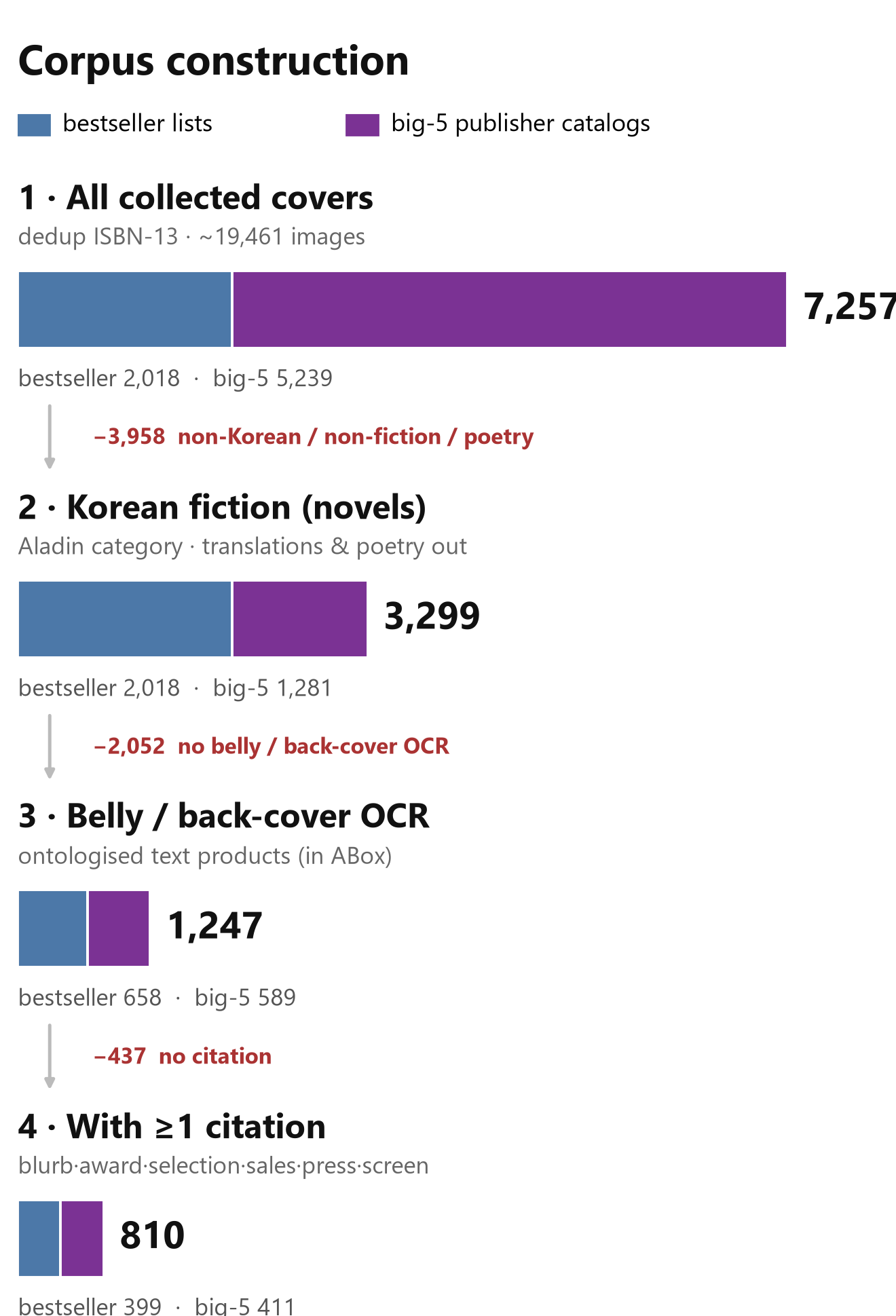
두 arm 을 합쳐 표지 이미지 7,257종을 수집했고, 한국소설로 한정(3,299) → 띠지/뒷표지 텍스트 OCR 성공(1,247) → 인용 권위 블록 1개 이상 보유(810)로 좁혔다. 탈락은 대부분 번역서·비소설·시집(−3,958)과 표지에 추출할 텍스트가 없는 경우(−2,052)다.
Across both arms 7,257 cover images were collected, narrowed to Korean fiction (3,299), then to covers whose belly-band/back-cover text was successfully OCR'd (1,247), then to those carrying at least one citation block (810). The bulk of the attrition is translations, non-fiction and poetry (−3,958) and covers with no extractable paratext (−2,052).
15.2 표면별 분업 — 띠지는 제도, 뒷표지는 담론15.2 A division of labour between the two surfaces
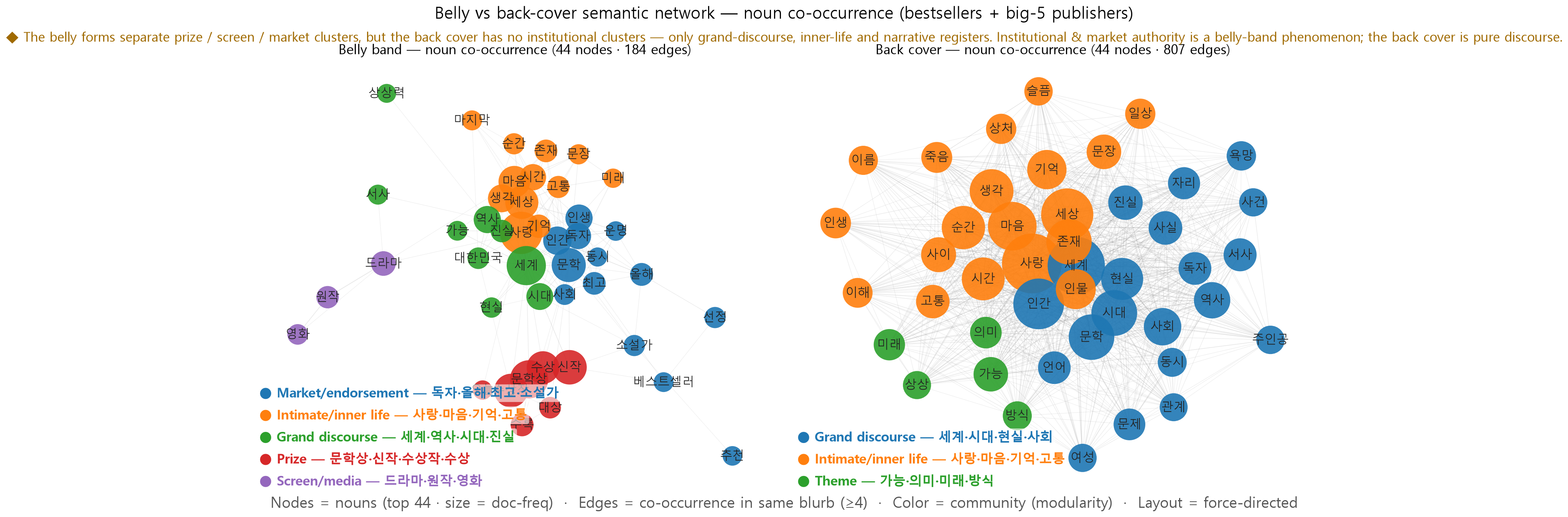
띠지 연결망은 제도적으로 구별되는 여러 군집(수상·영상화·시장·서사)으로 갈라지는 반면, 뒷표지 연결망은 주제 담론 한 덩어리(내면·거대담론·서사-구성)로 뭉친다. 이는 §12.2 블록 분포와 정확히 같은 이야기다 — 띠지에는 서로 다른 제도가 각자의 어휘를 들고 들어와 자리를 나눠 갖고, 뒷표지에서는 그 구분이 사라지고 텍스트에 대해 말하는 하나의 담론만 남는다.
The belly-band network splits into institutionally distinct clusters (prize, screen adaptation, market, narrative), while the back-cover network coheres into one thematic mass (interiority, grand discourse, narrative craft). This is the same story the block distribution tells in §12.2: on the belly band several separate institutions each bring their own vocabulary and occupy their own territory; on the back cover those distinctions dissolve into a single discourse about the text.
⚠️ 이 그림만 big-5 arm 을 합산한다(뒷표지 +약 570권). big-5 는 비베스트셀러 문학서가 많아 뒷표지 담론을 비평·문학 쪽으로 기울인다.⚠️ This is the only figure that pools the big-5 arm (+~570 back covers). Because the big-5 titles are largely non-bestselling literary fiction, they tilt back-cover discourse toward the critical/literary register.
15.3 부착율 재기준화와 표면별 분업15.3 Rebasing the denominator, and who sits on which surface
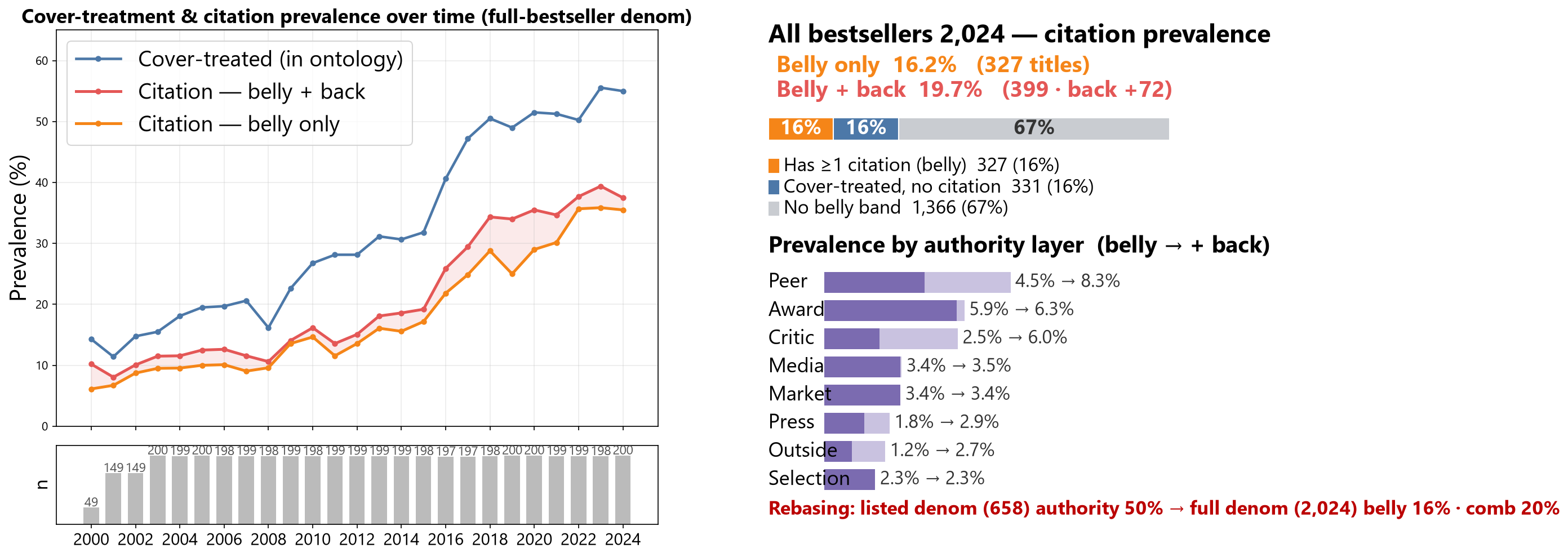
등재 코퍼스를 분모로 쓰면 권위 부착율이 약 50%로 보이지만, 전체모집단으로 재기준화하면 띠지 16% · 통합 20%다. 남는 67%는 띠지 자체가 없는 책이며, 이들은 무작위가 아니라 출판사 주도 패턴을 보인다 — 문학과지성사·민음사처럼 시리즈 디자인이 확립된 출판사, 그리고 전집·재간·연작소설집이 여기 몰린다. 즉 "띠지를 두르지 않는 것" 역시 하나의 편집 전략이다.
Measured against the ingested corpus, authority looks near-ubiquitous (~50%); rebased on the full population it is 16% on the belly band, 20% including the back cover. The remaining 67% have no belly band at all — and they are not a random remainder but follow a publisher-driven pattern: houses with an established series livery (Moonji, Minumsa), plus collected works, reissues and linked story collections. Going bare is itself an editorial strategy.
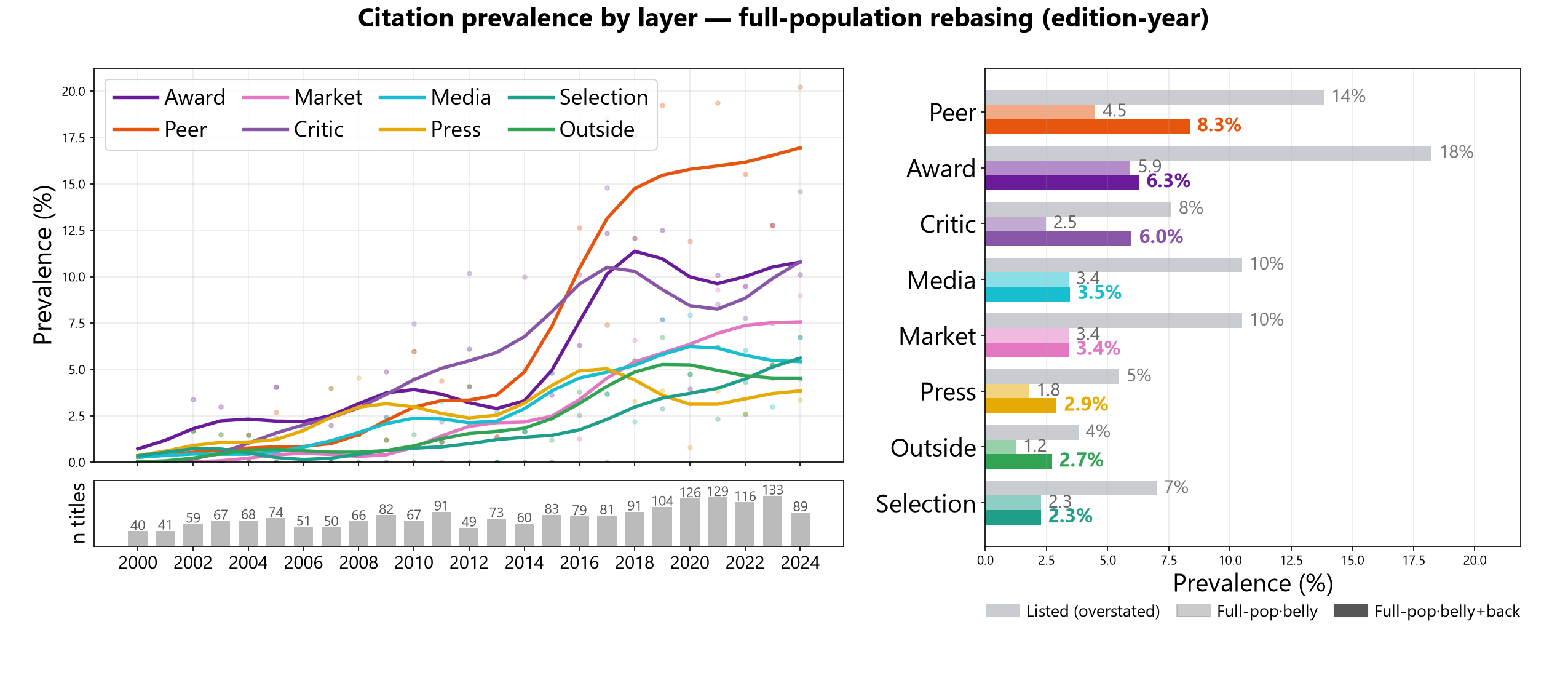
계층별로 보면 뒷표지를 포함시켰을 때 가장 크게 늘어나는 것이 비평(2.5%→6.0%, 2.4배)과 동료 추천(4.5%→8.3%)이다. 반대로 수상(5.9→6.3)·시장(3.4→3.4)·선정(2.3→2.3)은 거의 변하지 않는다.
공간적 분업 — 버려지는 면과 남는 면. 이 비대칭은 계측의 문제가 아니라 면의 수명에 맞춘 배치 전략이다. 수상·시장·선정처럼 제도가 발급한 자격은 벗겨서 버리는 띠지에 실리고, 비평과 동료 추천처럼 논증이 필요한 말은 책에 남는 뒷표지에 머문다. 자격은 선언하면 끝나지만, 논증은 책과 함께 살아남아야 하기 때문이다. 따라서 띠지만 보면 비평가의 몫이 체계적으로 과소평가된다 — 비평은 뒷표지에서 일한다.
그리고 2016년, 순위가 바뀐다. 판본연도 시계열에서 동료작가(peer) 추천이 2016년에 비평·수상을 동시에 추월하고, 이후 격차를 벌리며 가장 흔한 인용 권위로 자리 잡는다(2024년 기준 동료 17.0% vs 비평 10.8%·수상 10.8%·시장 7.6%). 수상은 높은 수준을 유지하지만 비평을 지속적으로 앞지르지는 못하고, 시장 계열은 사실상 0에서 출발해 꾸준히 상승한다. 책을 승인하는 목소리가 제도에서 동료로 옮겨간 것이며, 이 이동은 §15.8의 성별 구성 변화와 시기가 겹친다.
Adding the back cover changes the picture unevenly: critic authority grows 2.5% → 6.0% (×2.4) and peer endorsement 4.5% → 8.3%, while awards (5.9 → 6.3), market (3.4 → 3.4) and selections (2.3 → 2.3) barely move.
A spatial division of labour — the surface you discard and the surface you keep. The asymmetry is not a measurement quirk but a placement strategy matched to the lifespan of each surface. Credentials issued by an institution — prizes, sales figures, selections — ride the strip you peel off and throw away; claims that have to be argued — criticism, peer endorsement — stay on the back cover that remains with the book. A credential is finished once it has been declared; an argument has to survive alongside the text. Looking only at belly bands therefore undercounts the critic systematically: criticism does its work on the back cover.
And in 2016 the ranking flips. On the edition-year series, peer endorsement overtakes both critic and award authority in 2016 and pulls away to become the most common cited authority (2024: peer 17.0% vs critic 10.8%, award 10.8%, market 7.6%). Prizes hold a high level but never durably outrank critics, while market claims climb steadily from near zero. The voice that authorises a book has shifted from the institution to the peer — a movement that coincides in time with the change in the gender composition of endorsers (§15.8).
⚠️ 계층 라벨은 두 개의 직교축이 섞여 있다 — 추천인 신분(동료·비평·외부)과 권위 원천(수상·선정·언론·시장·미디어). 한 책이 여러 계층에 중복 계수될 수 있다.⚠️ The layer labels mix two orthogonal axes — the endorser's standing (peer / critic / outsider) and the source of authority (award / selection / press / market / media). A title may count in several layers.
15.4 시간축을 어떻게 잡을 것인가15.4 Choosing a time axis
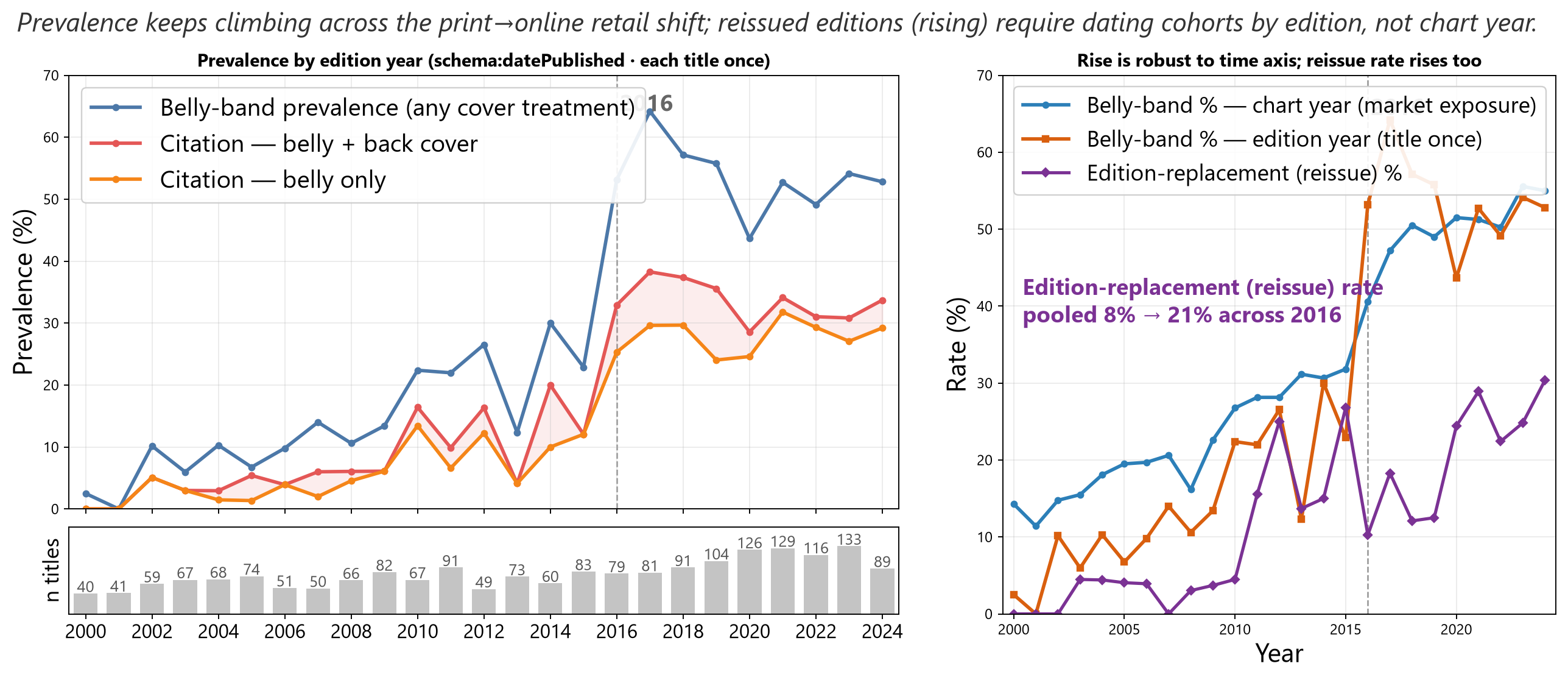
표지 이미지는 언제 수집하든 그 시점의 최신 판본이다. 따라서 "1998년 베스트셀러"의 표지를 1998년 자료로 취급하면 안 된다. 내용의 시계열은 판본일(schema:datePublished)로, 시장 노출의 시계열은 차트연도로 잡아야 한다.
이 선택은 편향을 하나 끌어들인다. 재간(再刊)율 — 현재 스캔된 판본이 그 책의 첫 차트 등장보다 늦은 비율 — 은 2000–2015년 8%에서 2016–2024년 21%로 뛴다. 구작이 최신 표지로 재간되면 그 책은 최근 연도 분모로 이동하므로, 판본일 축만 보면 2016년 이후의 상승을 재간의 산물로 의심할 수 있다. 실제로 이것이 이 시계열에 던질 수 있는 가장 날카로운 반론이다.
그러나 상승은 재간에 면역인 축에서도 그대로 나타난다. 차트연도 기준 표지처리율은 2013년 31%에서 2024년 55%로 꾸준히 오른다. 재간이 만들어낸 착시라면 이 선은 평평해야 하는데 그렇지 않다. 게다가 재간 편향은 분모를 키우는 방향이라 부착율을 낮추는 쪽으로 작동한다 — 그런데도 오른다. 두 축이 함께 오른다는 사실이 이 시계열의 근거다. (판본연도 기준 부착율은 2016년 53%에 이른다.)
A cover image is always the edition current at the time of scanning, so the cover of a "1998 bestseller" is not 1998 evidence. Content-side series must therefore be dated by edition year (schema:datePublished) and market-side series by chart year.
That choice imports a bias. The edition-replacement (reissue) rate — the share of titles whose currently scanned edition post-dates their first chart appearance — jumps from 8% (2000–2015) to 21% (2016–2024). When an older title is reissued with a new cover it moves into a recent year's denominator, so on the edition-year axis alone one could suspect the post-2016 rise of being an artefact of reissuing. This is the sharpest objection available against this series.
But the rise also appears on the axis that is immune to reissuing. On chart year, cover-treatment prevalence climbs steadily from 31% in 2013 to 55% in 2024. Were the trend an illusion produced by reissues, that line would be flat; it is not. Moreover the reissue bias inflates the denominator and therefore pushes prevalence down — and prevalence still rises. That both axes rise together is what this series rests on. (On the edition-year basis, prevalence reaches 53% in 2016.)
- 첫 차트연도 = 그 ISBN이 연도별 베스트셀러 목록에 처음 오른 해. 원자료는
yearly_bestsellers_*/covers/bestseller_metadata.json. - 판본연도 = 알라딘 메타의
pubDate에서 뽑은 연도. 같은 ISBN이 여러 해 목록에 걸쳐 있으면 가장 늦은 값을 쓴다(= 현재 유통 중인 판본).
- 왜 풀링해서 읽는가. 연 단위 값은 분모가 40–133권이라 크게 흔들린다(2015년 26.8% → 2016년 10.3% → 2017년 18.3%). 특정 한 해를 집어 논증하면 체리피킹이 되므로, 이 페이지는 2000–2015년 86/1,017 = 8.5%, 2016–2024년 201/948 = 21.2% 로 구간 풀링해 보고한다.
- 이 값은 하한이다.
pubDate자체가 이미 최신 판본 기준이라, 차트 등장 이전에 이미 여러 번 재간된 책은 포착되지 않는다. - 산출 함수는
build_bookcount_timeseries.py의reissue_series().
- First chart year — the first year that ISBN appears in an annual bestseller list, from
yearly_bestsellers_*/covers/bestseller_metadata.json. - Edition year — the year parsed from Aladin's
pubDate. Where one ISBN spans several annual files, the latest value is kept (i.e. the edition currently in circulation).
- Why it is read pooled. Annual values swing widely on denominators of 40–133 titles (2015: 26.8% → 2016: 10.3% → 2017: 18.3%). Arguing from any single year would be cherry-picking, so this page reports pooled figures: 86/1,017 = 8.5% for 2000–2015 and 201/948 = 21.2% for 2016–2024.
- It is a lower bound. Because
pubDatealready refers to the current edition, titles reissued repeatedly before they charted are invisible to this measure. - Computed by
reissue_series()inbuild_bookcount_timeseries.py.
15.5 띠지는 절반만 남의 권위를 빌린다15.5 Half of all belly bands borrow no authority at all
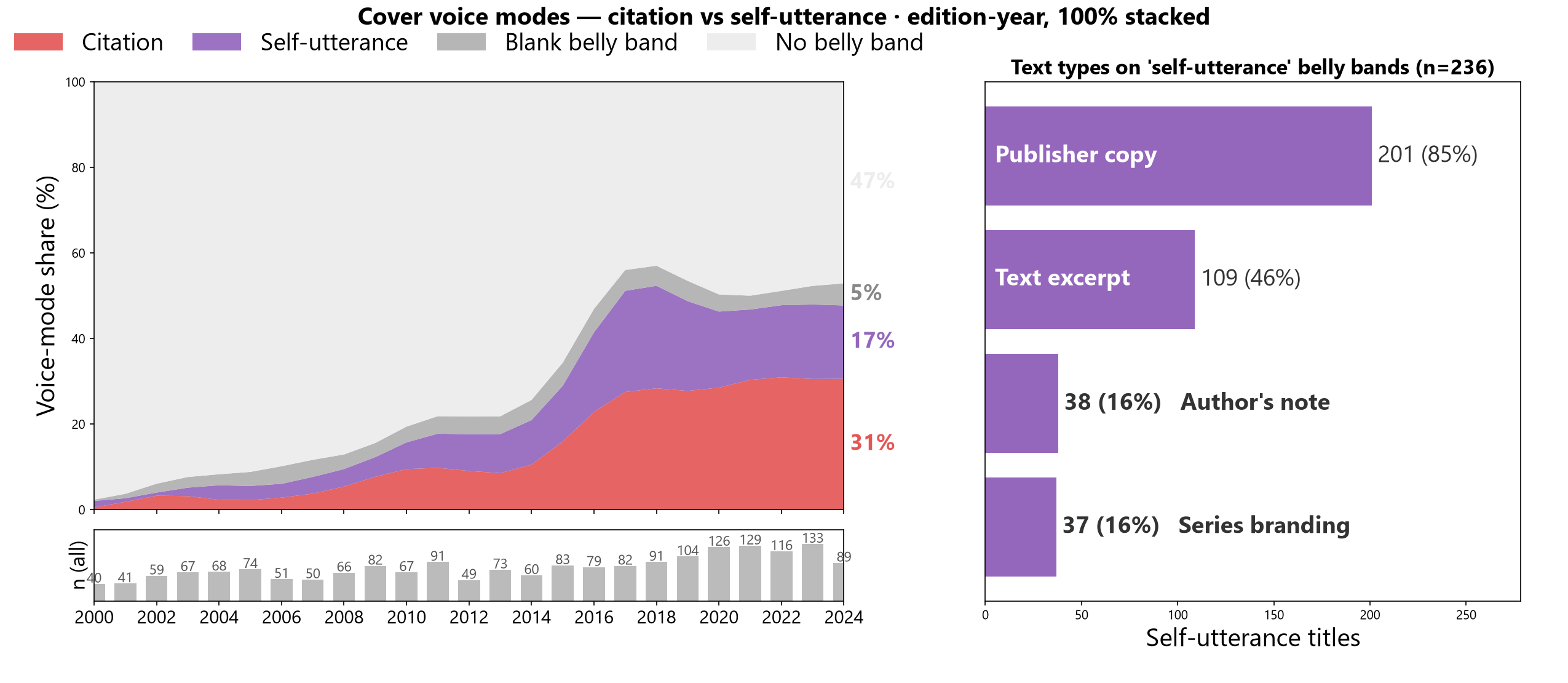
띠지를 두른 651권 중 48%는 외부 권위를 전혀 인용하지 않는다. 출판사 카피·본문 발췌·작가의 말·시리즈 브랜딩처럼 책 자신의 목소리로 말하거나(236권), 아예 텍스트가 없다(75권). 띠지를 "남의 명성을 수입하는 장치"로만 보는 통념은 절반만 맞다.
그 자기발화 236권 안에서는 출판사가 직접 쓴 홍보 카피가 201권(85%)으로 압도적이고, 본문 발췌 109권(46%)·작가의 말 38권(16%)·시리즈 브랜딩 37권(16%)이 뒤따른다(한 띠지가 여러 유형을 겸할 수 있어 합은 100%를 넘는다). 즉 띠지가 "책 자신의 목소리"로 말할 때 그 목소리는 대개 출판사의 것이다.
Of the 651 belly-treated titles, 48% cite no external authority whatsoever: they speak in the book's own voice — publisher copy, an excerpt, the author's note, series branding (236 titles) — or carry no text at all (75). The common view of the belly band as a device for importing borrowed prestige is only half right.
Within those 236 self-utterance bands, publisher-written promotional copy dominates at 201 titles (85%), followed by an excerpt from the text (109, 46%), the author's note (38, 16%) and series branding (37, 16%); a single band may combine several types, so the shares sum to more than 100%. When the band speaks in "the book's own voice", in other words, that voice usually belongs to the publisher.
15.6 주체가 아니라 기능으로 — 발화행위 축15.6 From speakers to speech acts
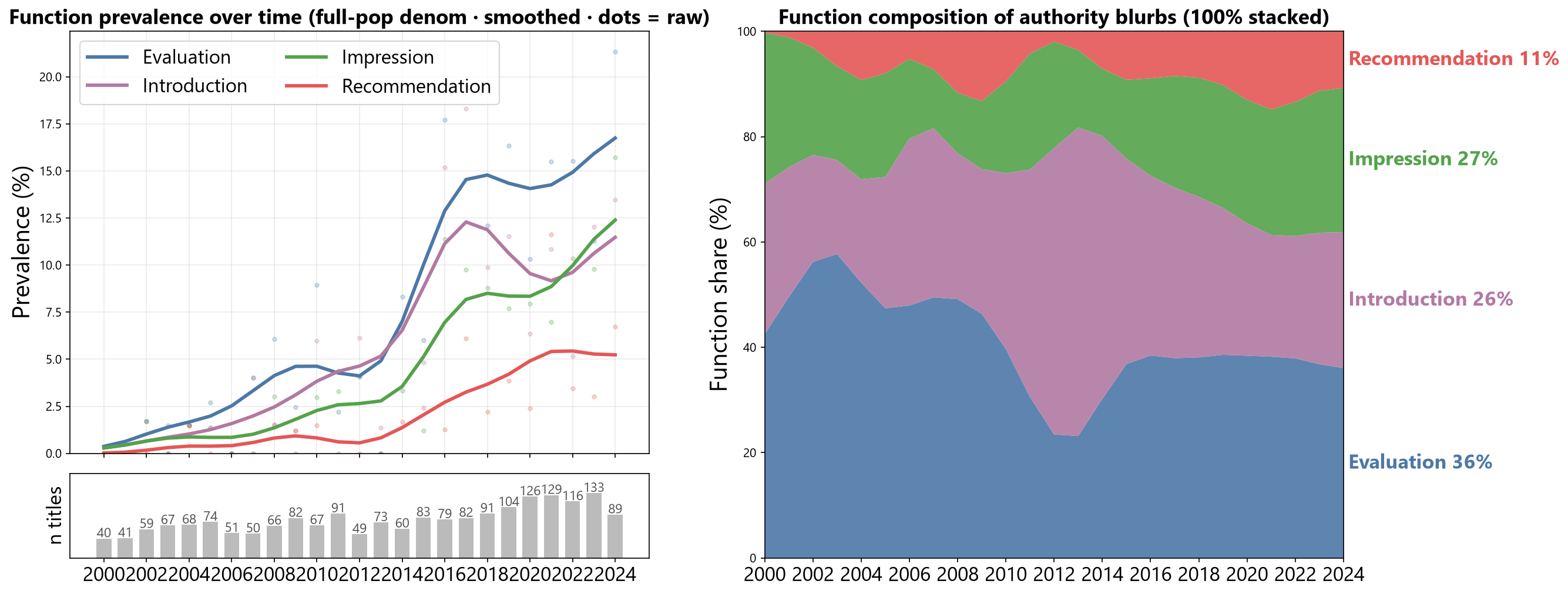
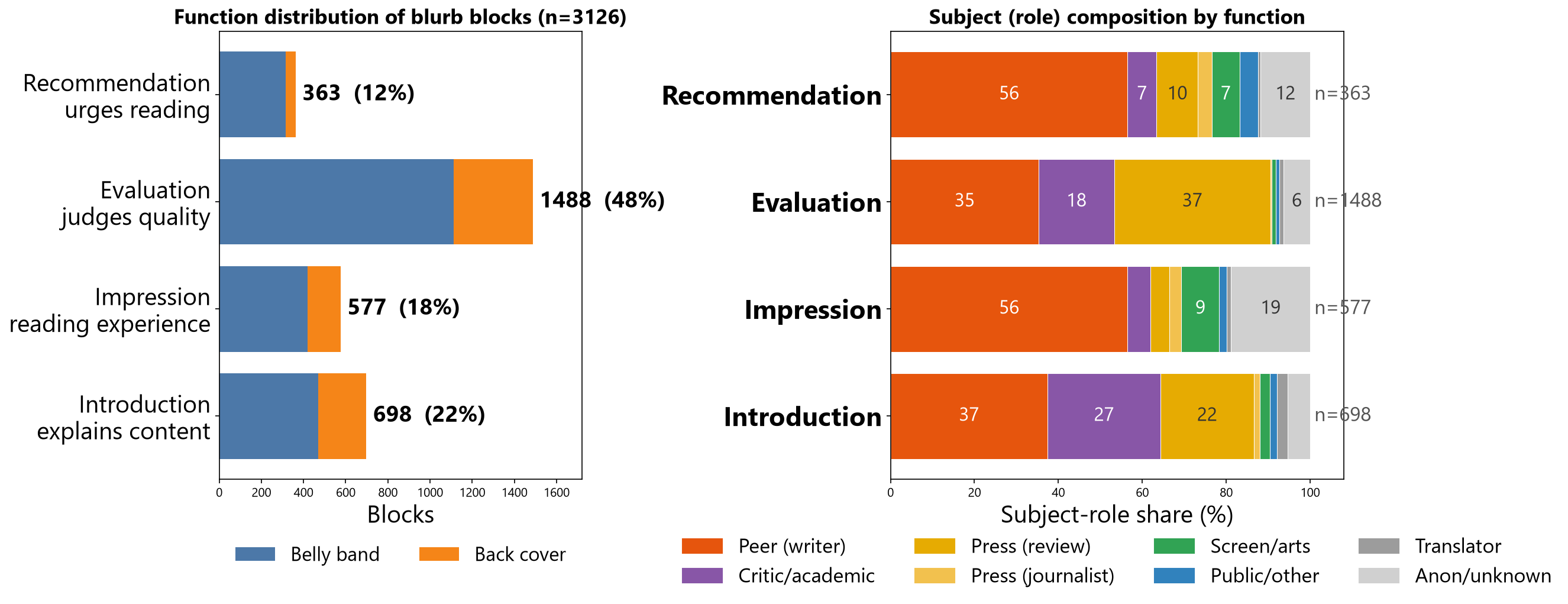
"누가 말했나"(동료작가·평론가·언론) 대신 "무엇을 하는 말인가"로 블러브를 분류하면 네 가지 기능이 나온다 — 평가(질을 판단) · 소개(판단 없이 설명) · 감상(독서 경험) · 권유(읽기를 권함). 평가가 지배적이고 권유는 가장 신생·최소다. 2024년 구성비로는 평가 36%·감상 27%·소개 26%·권유 11%이고, 블록 전체(n=3,126)로 세면 평가 1,488(48%)·소개 698(22%)·감상 577(18%)·권유 363(12%)이다. 네 기능 모두 시간에 따라 부착율이 오른다.
기능을 발화 주체와 교차하면 노동 분업이 드러난다. 동료작가는 권하고 반응하며(권유·감상 모두 동료작가 56%), 언론은 평가하고(평가의 37%가 언론 서평), 비평가·연구자는 설명한다(소개에서 27%로 최고). 즉 비평적 권위는 해설적이지 권유적이지 않다. 이 축의 이점은 주체 축이 못 보는 것을 본다는 데 있다 — 같은 평론가가 띠지에서는 선언하고 뒷표지에서는 논증한다.
Classifying blurbs by what the utterance does rather than who said it yields four functions: evaluation (judges quality), introduction (explains without judging), impression (reports the reading experience) and recommendation (urges you to read). Evaluation dominates and recommendation is the newest and smallest. In the 2024 mix the shares are evaluation 36%, impression 27%, introduction 26%, recommendation 11%; counted over all blocks (n = 3,126) they are evaluation 1,488 (48%), introduction 698 (22%), impression 577 (18%), recommendation 363 (12%). All four rise in prevalence over time.
Crossing function with speaker reveals a division of labour. Fellow writers recommend and respond (peers account for 56% of both recommendation and impression), the press evaluates (press reviews are 37% of evaluation), and critics and academics explain (they peak at 27% of introduction). Critical authority, in other words, is exegetical rather than hortatory. The value of this axis is that it sees what the speaker axis cannot: the same critic declares on the belly band and argues on the back cover.
⚠️ 기능 코딩은 Gemini(temp 0) 2단계 추출이며, 독립 재코딩 150건 기준 Cohen's κ = 0.66이다(평가↔소개 경계가 가장 물렁). 판본일 기준이라 구작 재간이 최근 연도에 쌓이는 현재판 편향이 있다.⚠️ Functions were coded by Gemini (temp 0) in two passes; against an independent re-code of 150 items, Cohen's κ = 0.66 (the evaluation/introduction boundary is the softest). The edition-year basis means reissued older titles pile into recent years.
15.7 핵심 발견 — 성별(聖別)↔시장 축15.7 The central finding — a consecration ↔ market axis
- 대상을 좁힌다. 띠지와 뒷표지를 모두 가진 책만 쓴다. 띠지에서는 권위 유형을, 같은 책 뒷표지에서는 담론을 읽어 둘을 대응시킨다.
- 텍스트를 정제한다. 뒷표지에서 담론 블록(추천·출판사 카피·발췌·작가의 말·언론)만 남기고 제도 인용블록(수상·판매·선정·시리즈·미디어)은 제외한다. 이어 아파라투스 문자열(
세계문학상·심사·위원·수상작·베스트셀러·N만부·판권·선정·우수)을 매칭 전에 삭제한다 — 상 이름이 담론어로 위장하는 것을 막기 위해서다. - 두 어휘로 이진 판정한다. 블록마다 비평어 24개(문장·문체·서사·묘사·표현·미학·완성도 …) 중 1개 이상 포함하는지, 정서어 22개(감동·위로·눈물·가슴·공감·힐링 …) 중 1개 이상 포함하는지를 각각 본다. 빈도가 아니라 보유 여부다.
- 코퍼스 평균 대비로 환산한다. enrichment = (그 권위 유형 안에서의 보유율) ÷ (코퍼스 전체 보유율).
- 읽는 법. 0 = 코퍼스 평균과 같은 균형. 양수는 비평 쪽, 음수는 정서 쪽. log2 이므로 +1은 2배, +2.46은 약 5.5배 비평 쪽으로 치우쳤다는 뜻이다.
- 순환논증 차단. 두 어휘 목록은 검증 대상인 "띠지 권위 유형과의 연관"에서 뽑지 않고, 수사학적 기준(형식·기예 vs 감정)으로 미리 정의했다. 즉 답을 보고 자를 만들지 않았다.
- 오차막대 = 어휘 leave-one-out. 46개 단어를 하나씩 빼고 46번 다시 계산한 값의 범위다. 결과가 특정 단어 한두 개에 좌우되지 않음을 보이는 장치이며, 도서 부트스트랩이 아니므로 표본 불확실성은 담지 않는다.
- 기각한 대안 2종. 초기의 거대↔정서 축은 내용(무엇에 관한 책인가) 축이라 두 극이 융합했고(OR 1.44) 권위 유형별로 평평했다. 세 번째 후보인 사회·정치 레지스터도 유형별 변별력이 없어(E ≈ 1.0–1.3) 폐기했다. 지금 축이 갈리는 이유는 그것이 내용이 아니라 태도(무엇으로 정당화하는가) 이기 때문이다.
- 산출:
build_consecration_axis.py.
- Restrict the sample. Only books carrying both surfaces are used: the authority type is read off the belly band, the discourse off the same book's back cover, and the two are paired.
- Clean the text. On the back cover only discourse blocks are kept (endorsement, publisher copy, excerpt, author's note, press); institutional-citation blocks (award, sales, selection, series, media) are excluded. Apparatus strings (prize names, "jury", "judge", "prizewinning work", "bestseller", "N copies sold", "selected", …) are then stripped before matching, so that the name of a prize cannot masquerade as discourse.
- Score each block as a binary. For every block, does it contain at least one of 24 critical words (sentence, style, narration, description, expression, aesthetics, craft …), and at least one of 22 affective words (moving, consolation, tears, heart, empathy, healing …)? Presence, not frequency.
- Express it relative to the corpus. enrichment = (rate within that authority type) ÷ (rate across the whole corpus).
- How to read it. Zero means the same balance as the corpus average; positive leans critical, negative affective. Because it is log2, +1 is a two-fold tilt and +2.46 roughly five-and-a-half-fold.
- Guarding against circularity. Neither word list was harvested from the belly-band association being tested; both were defined in advance on rhetorical grounds (form and craft vs emotion). The ruler was not cut after seeing the answer.
- Error bars = leave-one-out over the lexicons. The statistic is recomputed 46 times, each time dropping one word. The bars show that no single word or two drives the result; they are not a book-level bootstrap, so they carry no sampling uncertainty.
- Two rejected alternatives. An earlier grand ↔ affective axis was about content (what the book is about): its poles fused (OR 1.44) and it was flat across authority types. A third candidate, a socio-political register, failed to discriminate at all (E ≈ 1.0–1.3) and was dropped. The present axis separates because it measures stance — how the book is legitimated — rather than content.
- Computed by
build_consecration_axis.py.
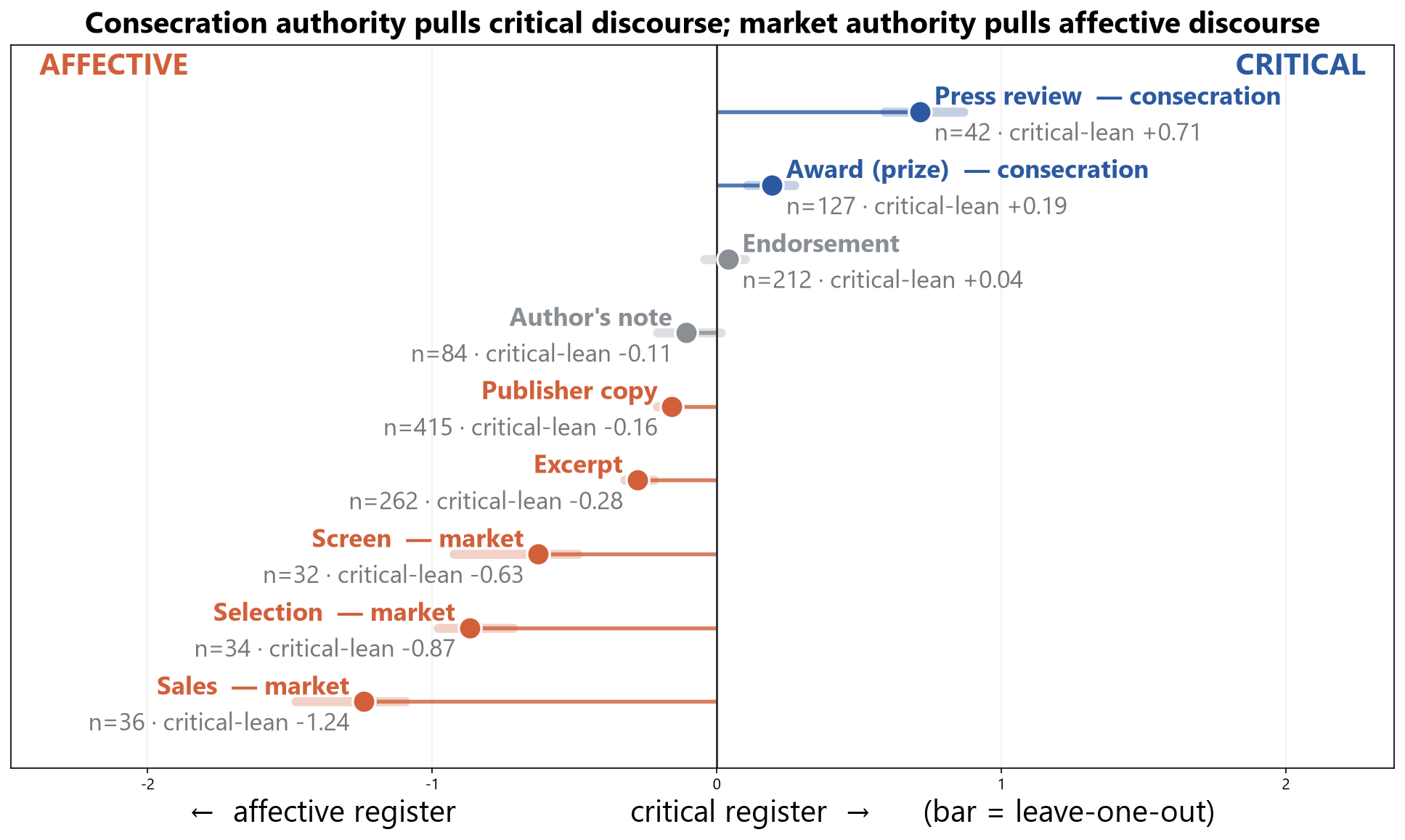
띠지가 인용한 권위의 종류가 같은 책 뒷표지의 말투를 예측한다.
- 성별(聖別) 권위 → 비평의 언어: 언론 평 +0.71(n=42), 수상 +0.19(n=127). 문체·서사·완성도를 말한다.
- 시장 권위 → 정서의 언어: 판매 실적 −1.24(n=36), 선정 −0.87(n=34), 영상화 −0.63(n=32). 감동·위로·눈물을 말한다.
- 중립: 추천 +0.04(n=212), 작가의 말 −0.11(n=84) — 둘 다 LOO 구간이 0을 가로질러 부호가 불안정하다.
- 자기발화는 약하게 정서 쪽: 출판사 카피 −0.16(n=415), 본문 발췌 −0.28(n=262). 그림에서 표본이 가장 큰 두 유형이며, 책이 스스로 말할 때는 시장 권위만큼은 아니어도 정서 쪽으로 기운다.
부르디외의 제한 생산(자율·성별) 대 대량 생산(타율·시장) 구분이 표지 파라텍스트에서 그대로 복원된다. 상·언론이 승인한 책의 뒷표지는 기예를 말하고, 많이 팔린 책의 뒷표지는 감정을 말한다.
- Consecrating authority → critical register: press review +0.71 (n = 42), prize +0.19 (n = 127). The talk is of style, narration, craft.
- Market authority → affective register: sales figures −1.24 (n = 36), selections −0.87 (n = 34), screen adaptation −0.63 (n = 32). The talk is of being moved, consoled, brought to tears.
- Neutral centre: endorsement +0.04 (n = 212), author's note −0.11 (n = 84) — both cross zero under leave-one-out, so the sign is unstable.
- Self-utterance leans mildly affective: publisher copy −0.16 (n = 415), excerpt −0.28 (n = 262). These are the two largest categories in the figure: when a book speaks for itself it tilts toward feeling, though nowhere near as far as market-backed titles do.
Bourdieu's distinction between restricted (autonomous, consecrated) and large-scale (heteronomous, market) production is recovered directly from cover paratext: the back cover of a prize- or press-backed book speaks of craft; the back cover of a bestseller speaks of feeling.
⚠️ 이 축은 분할이 아니라 기울기다 — 블록 수준에서 두 레지스터는 여전히 공기한다(OR 1.90). 시장 계열은 n 이 32–36으로 작아 "방향은 견고, 정밀도는 보통". 어휘는 검증 대상인 연관에서 뽑지 않고 수사 기준으로 사전 정의했으며, 제도 아파라투스 문자열(세계문학상·심사·위원·수상작·베스트셀러·N만부 등)은 매칭 전에 제거했다. 앞서 시도한 거대↔정서 이분법은 두 축이 융합(OR 1.44)하고 권위 유형별로 평평해 폐기했다. ⚠️ This is a lean, not a partition — at block level the two registers still co-occur (OR 1.90). The market types have modest n (32–36), so read it as "robust in direction, moderate in precision". The lexicons were defined on rhetorical grounds rather than harvested from the association being tested, and institutional-apparatus strings (prize names, jury, "bestseller", "N copies sold" …) were stripped before matching. An earlier grand ↔ affective dichotomy was discarded: the two poles fused (OR 1.44) and were flat across authority types.
15.8 비평의 언어에 이르는 두 갈래 길15.8 Two gendered routes into the critical register
먼저 시간. 동성 추천의 구성은 2017년 전후로 뒤집힌다 — 그때까지 우세하던 남성→남성 추천을 여성→여성 추천이 추월하고, 이후 격차가 벌어진다. §15.3에서 본 제도에서 동료로의 이동과 시기가 겹치며, 아래 4×4는 그렇게 자리를 넘겨받은 동료들이 어떤 목소리로 말하는지를 본다.
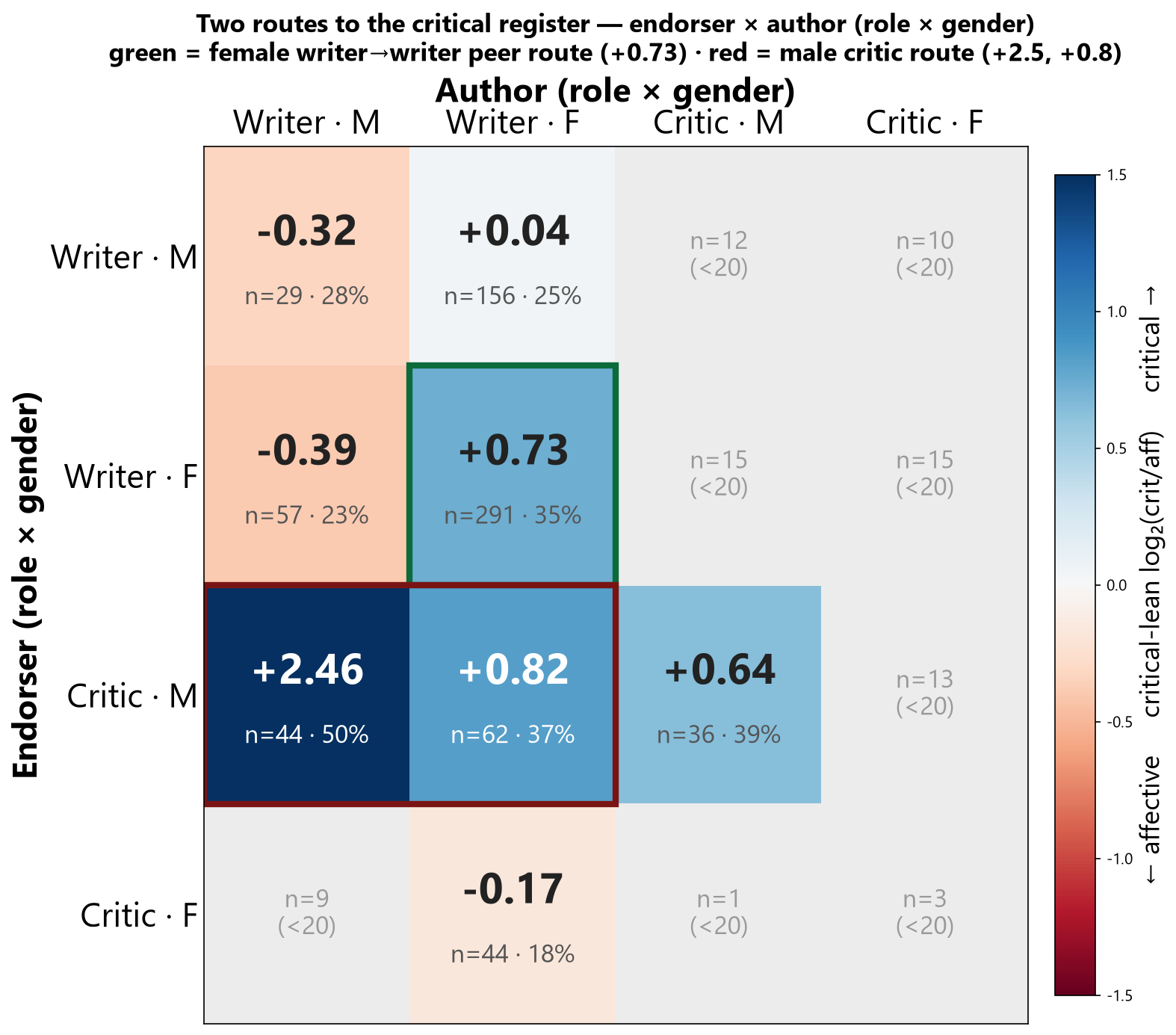
원래의 성별 히트맵은 "남성일수록 비평적"으로 읽혔지만 이는 역할 교란이었다 — 비평가는 원래 비평적으로 쓰고(lean +1.04 vs 동료작가 +0.30), 남성 추천인은 비평가일 확률이 3배(35% vs 11%)다. 역할을 통제해 4×4로 펼치면 두 개의 서로 다른 엔진이 드러난다.
- 남성 = 제도 경로. 비평가·남 → 작가·남 +2.46(n=44), → 작가·여 +0.82(n=62). 남성은 비평가라는 직함을 통해 비평의 언어에 도달한다.
- 여성 = 동료 연대 경로. 작가·여 → 작가·여 +0.73(n=291). 여성 작가들은 비평가 직함 없이 서로를 추천하며 기예-비평의 목소리를 취한다. 같은 자리의 남성 동료작가는 평평하거나 정서적이다(남→남 −0.32).
- 직함 자체가 성별(聖別)하는 것은 아니다. 비평가·여 → 작가·여는 −0.17(n=44)로 오히려 정서 쪽이다. 비평의 언어를 여는 것은 비평가라는 자리 그 자체가 아니라 남성이 그 자리에 앉았을 때다. 이 셀이 두 경로가 서로 다른 기제임을 보여주는 쐐기다.
즉 남성은 제도가 성별(聖別)하고, 여성은 서로를 성별한다. 여성 동료 생태계는 남성의 경로를 물려받은 것이 아니라 별도의 경로를 만들었다.
First, the timing. The composition of same-gender endorsement flips around 2017: female→female endorsement overtakes the male→male pairing that had dominated until then, and the gap widens afterwards. This coincides with the shift from institution to peer seen in §15.3 — and the 4×4 below asks in what voice those newly dominant peers speak.
The raw gender heatmap read "the more male, the more critical", but that was a role confound: critics write critically to begin with (lean +1.04 vs +0.30 for peer writers), and male endorsers are three times as likely to be critics (35% vs 11%). Controlling for role in a 4×4 separates two different engines.
- Men: the institutional route. Critic·M → Writer·M +2.46 (n = 44), → Writer·F +0.82 (n = 62). Men reach the critical register through the critic's chair.
- Women: the peer-solidarity route. Writer·F → Writer·F +0.73 (n = 291). Women novelists take up the craft-critical voice while endorsing each other, without holding the critic's role. Male peer writers in the same position are flat or affective (M→M −0.32).
- It is not the role in itself that consecrates. Critic·F → Writer·F runs −0.17 (n = 44) — mildly affective. What opens the critical register is not the critic's chair as such but a man occupying it. This cell is the wedge that shows the two routes are different mechanisms.
In short, men are consecrated by the institution; women consecrate one another. The female peer ecosystem did not inherit the male route — it built an alternative one.
⚠️ 여러 셀이 n<20(회색)이며, 비평가-저자 두 열은 전부 희박하다 — 소설 저자는 대부분 작가라는 자명한 구조 탓이지 신호가 아니다. 저자 역할은 메타데이터 키워드 추정이고, 성별은 KAC 전거 기준이다.⚠️ Several cells have n < 20 (greyed), including both critic-author columns — a trivial structural fact (novelists are overwhelmingly writers, not critics), not a signal. Author roles are inferred from metadata keywords and gender comes from KAC authority records.
15.9 한계15.9 Limitations
- 편집자는 보이지 않는다. 편집자는 메타데이터에도 추천사에도 등장하지 않는다. 따라서 이 코퍼스는 연출된(performed) 권위만 담으며, 실제로 그 연출을 생산한(produced) 편집 권력은 비가시 상태다. 결과를 "출판사가 이렇게 판단했다"로 읽으면 과대해석이다.
- 표지는 항상 현재판이다. 스캔 시점의 최신 판본이므로 구작일수록 원래 표지를 볼 수 없다(§15.4).
- 작은 n. 담론 레지스터 분석의 일부 세포는 표본이 작다. 방향은 견고하나 정밀도는 제한적이며, 어휘 기반 측정은 의미장 전체를 대표하지 않는다.
- 계층 라벨의 비일관성. 권위 계층은 추천인 신분과 권위 원천이라는 두 축이 섞인 라벨이다(§15.3 단서).
- 성별은 기관 기록이다. §15.8의 성별은 국립중앙도서관 전거(KAC)의 값을 그대로 쓴 것으로, 이름에서 추정하지 않았다. 다만 이진값이고 자기식별이 아니며, 전거 레코드가 없는 인물은 분석에서 탈락한다. 따라서 이 결과는 제도가 추천인을 어떻게 분류하는가로 읽어야 한다.
- Editors are invisible. Editors appear neither in the metadata nor in the blurbs. The corpus therefore records only performed authority; the editorial power that actually produced that performance is out of view. Reading these results as "the publisher judged the book this way" overstates them.
- Covers are always the current edition — the older the title, the less likely its original cover survives in the sample (§15.4).
- Small cells. Some cells in the register analyses rest on few titles: directions are robust, precision is limited, and lexicon-based measurement does not represent a whole semantic field.
- Layer labels are not clean. The authority layers mix endorser standing with authority source (see the caveat in §15.3).
- Gender is an institutional record. The gender used in §15.8 is taken verbatim from the National Library of Korea's authority file (KAC); it was not inferred from names. It is nevertheless binary rather than self-identified, and people without an authority record drop out of the analysis. These results should therefore be read as how the institution classifies endorsers.
문서 끝.End of document.